Keeping Up as AI Search Transforms Content Discovery
As AI search engines like ChatGPT and Google AI Overviews fundamentally transform how users discover information, many organizations struggle to keep pace. The shift from ranking for blue links to being cited as an authoritative source creates a critical gap for companies still tethered to legacy SEO workflows. Scaling content for AI search requires refining your digital output to ensure it is accurate, machine-readable, and inherently valuable to large language models.
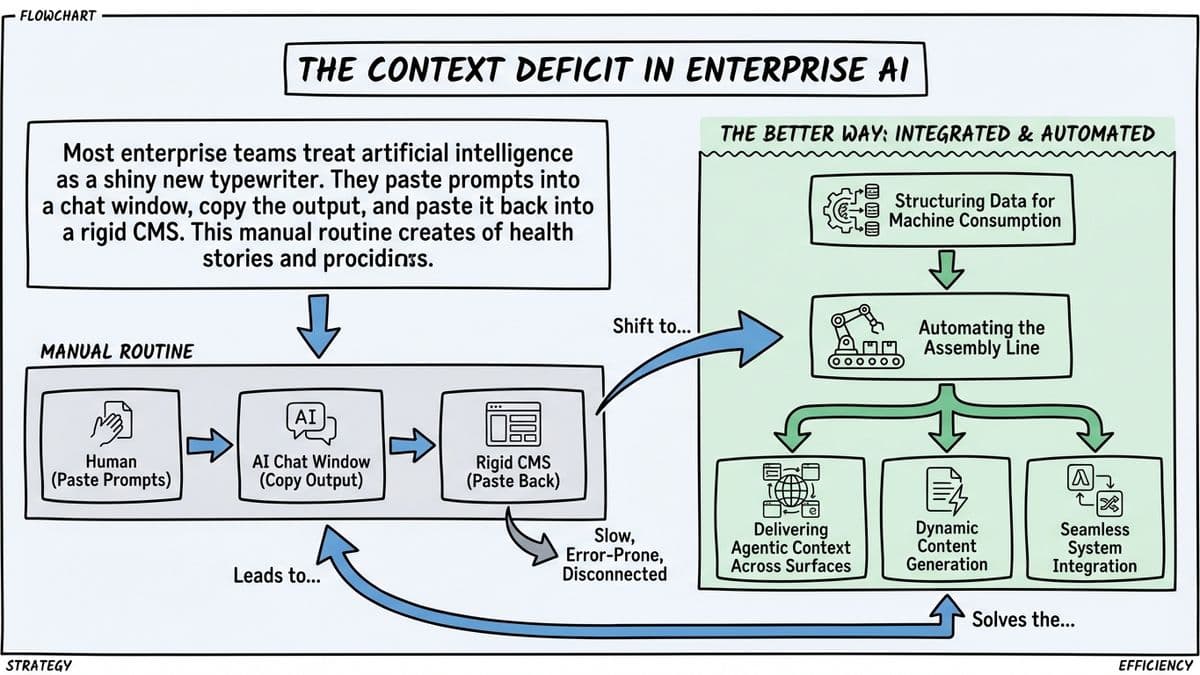
Many organizations find that their existing content architecture, often characterized by unstructured HTML, fails to provide the semantic clarity that AI agents require. To remain visible, brands must move toward a model where content is treated as structured, relational data. By adopting a phased approach that prioritizes data integrity and governance, you can transform your strategy into an efficient AI content pipeline.
Phase 1: Establishing the Data Foundation
Before you can effectively leverage generative AI, you must ensure your underlying content is clean, accessible, and logically structured. Scaling content for AI search requires moving beyond page-based thinking toward a model where information is treated as machine-readable assets. If your CMS contains unstructured HTML, AI models will struggle to parse relationships, often leading to hallucinations or poor citation performance.
Audit and Refine Your Assets
To begin your AI-ready transition, audit your existing CMS assets. Your goal is to identify and resolve fragmentation—those disconnected pages that lack semantic clarity. Ensure every page has a defined search intent and a unique canonical URL. By eliminating thin or redundant content, you reduce the noise that AI crawlers filter through, making it easier for your high-quality pages to be surfaced.
The Power of Structured Data
Structured data is the bridge between your human-readable content and an AI’s understanding of your organization. Implementing Schema.org markup using JSON-LD provides machines with explicit context regarding your entity, products, and processes. Using schemas like FAQPage or HowTo helps answer engines identify direct, extractable answers, which is the cornerstone of a successful AEO strategy.
Technical Readiness Checklist
Building a robust AI content pipeline relies on a foundation of technical stability. AI agents require clean, fast, and accessible pathways to consume your information. Review your current technical setup against the requirements below to ensure you are prepared for generative search optimization:
| Requirement | Purpose | AI/AEO Impact |
|---|---|---|
| HTTPS | Security | Signals trustworthiness to crawlers |
| XML Sitemap | Navigation | Ensures all pages are discoverable |
| Responsive Design | Mobile-first | Matches mobile-first AI indexing |
| Valid JSON-LD | Machine-readable | Clarifies content entity relationships |
| Crawl Access | Robot visibility | Allows GPTBot/Google-Extended to index |
Phase 2: Starting Small with Low-Risk Automation
The goal of scaling for AI search is not to replace your creative team with automation. Instead, the most effective approach is to start with low-risk tasks that support your broader AEO strategy. By focusing on technical, behind-the-scenes processes, you can streamline operations without jeopardizing the quality of your primary content.
Targeting Low-Risk Wins
Start your automation journey with tasks that are highly repetitive and technical. Generating metadata, drafting automated summaries for long-form reports, and creating internal linking suggestions are perfect starting points. These tasks improve discoverability and semantic structure without requiring the unique human voice that defines your brand’s authority.
| Feature | Manual Workflow | AI-Assisted Workflow |
|---|---|---|
| Speed | Slow (Hours/Days) | Fast (Seconds/Minutes) |
| Accuracy | High (Human-checked) | High (Human-in-the-loop) |
| Scaling | Limited by headcount | Virtually unlimited |
| Consistency | Varies by individual | High (Brand-aligned) |
Implementing Human-in-the-Loop Review
Automation does not mean you stop reviewing the output. To maintain E-E-A-T signals, you must establish a rigorous human-in-the-loop review process. Before any AI-generated metadata or summary goes live, a subject matter expert should review it for factual correctness. This is critical for generative search optimization, where a single hallucination could damage your credibility.
Phase 3: Building Governance and Compliance at Scale
Maintaining brand integrity becomes the most significant challenge when scaling content. To prevent AI from deviating from your established brand voice, implement strict guardrails within your AI content pipeline. This involves creating a centralized library of approved brand assets and tone descriptors that the system references before every generation.
Managing Legal and Compliance Reviews
Automating the review process is essential for enterprise-level operations. By implementing field-level validation rules, you can automatically flag content containing non-compliant claims or outdated legal disclaimers.
| Compliance Step | Automated Action | Purpose |
|---|---|---|
| Fact Check | Cross-reference with internal API | Ensures accuracy and prevents misinformation |
| Style Audit | Compare text against style guide | Maintains consistent brand persona |
| Policy Check | Filter against forbidden keyword list | Avoids legal liability and reputation risk |
Maintaining Authority with E-E-A-T
When your content is ingested by AI engines, clear attribution is your best defense against misinformation. Prioritize AI-ready content explicitly grounded in your own expertise. Every piece of automated content should carry metadata that signals its source, including the name of the human expert who reviewed it and primary source citations.
Phase 4: Integrating AI Content into Marketing Campaigns
Once your foundational data architecture is secure, transition from simple prompt-based automation to API-driven workflows. Scaling content for AI search requires shifting your perspective from merely producing articles to orchestrating a content ecosystem that feeds LLMs the structured information they crave.
Repurposing Pillars into AI-Extractable Answers
Your existing long-form content is a goldmine, but AI engines often struggle to extract value from unstructured HTML. Restructure your pillar pages into bite-sized, AI-ready segments. By adopting an answer-first approach—leading with a 40–60 word direct, self-contained definition—you provide a perfect snippet for LLMs to quote. Break down complex pillars into atomic units that include:
- Definition-style sentences (“X is a…”).
- Numbered procedural steps for how-to queries.
- Comparative tables that contrast your solutions with alternatives.
- FAQ sections marked up with JSON-LD to confirm semantic intent.
Successfully scaling content for AI search is a strategic shift toward building a high-trust, machine-readable brand entity. By prioritizing clarity, structured data, and authoritative, answer-first content, you transform your website into a reliable knowledge base that answer engines can consistently trust and cite.
AEO/GEO
Want to learn more?
Contact us for direct consultation and support.