Scaling Content for AI Search: Beyond Volume
You’ve been there: you’ve invested countless hours and significant resources into an aggressive publishing schedule. Your team produces high-volume AI-generated content, yet search analytics remain stagnant. Your pages aren’t being cited, your brand isn’t appearing in AI-driven summaries, and topical authority feels out of reach. It’s a cycle that leaves many marketers feeling like they are shouting into a digital void while competitors capture the spotlight with a fraction of the output.
This disconnect is the AI Authority Gap. In the race to fill the web with information, many businesses mistake volume for relevance. However, modern AI answer engines—such as Google’s AI Overviews, Perplexity, and ChatGPT—no longer reward simple mass production. They prioritize systems that synthesize clear, entity-rich answers to build trust through precision.
Scaling content for AI search isn’t just about doing more; it is about doing what is necessary to be cited, surfaced, and quoted. By understanding why the “volume-first” approach fails, you can pivot toward a strategy that prioritizes the structural and semantic needs of generative engines. This guide helps you bridge that gap, transforming your content from noise into a foundation of machine-verifiable authority.
The Illusion of Volume: Why More Content Isn’t Always Better
Many businesses believe the volume of their output determines their visibility in an AI-driven world. When you prioritize quantity over substance, you flood your site with generic information that lacks the unique perspective required to stand out. This approach to scaling content for AI search often leads to topic saturation, where you produce pages covering broad ideas but failing to provide the deep, nuanced answers modern AI models crave. By focusing on how much you publish rather than how much you teach, you risk diluting your authority and confusing the engines you want to impress.
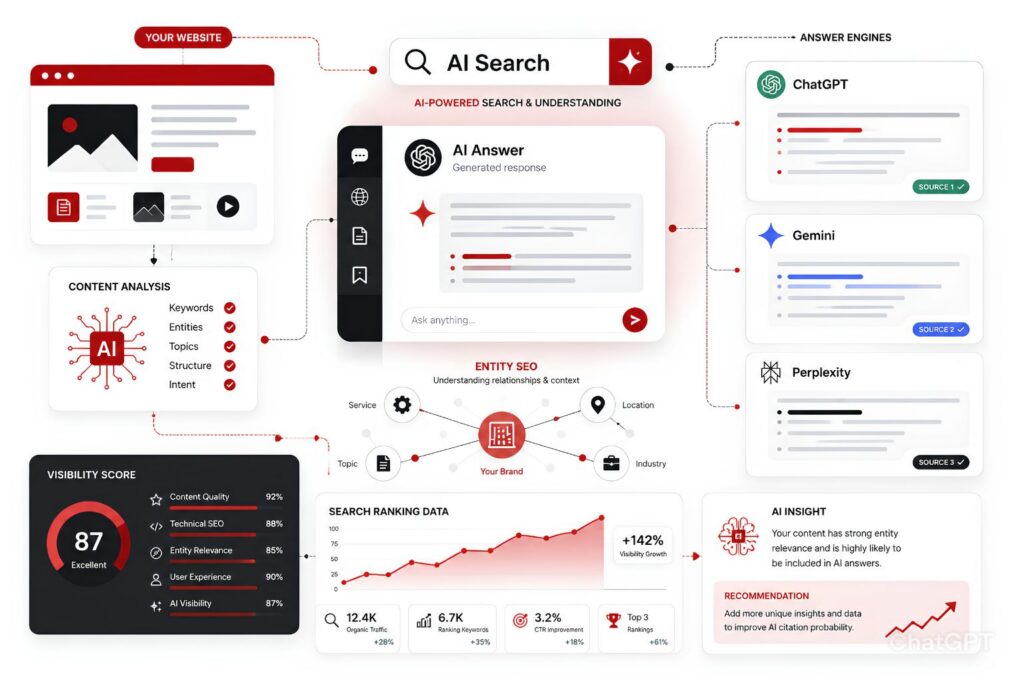
Why AI Engines Crave Insight Over Volume
Search and answer engines are increasingly sophisticated at evaluating content based on E-E-A-T signals. When an AI model evaluates which source to cite, it looks for information that is synthesized, authoritative, and structurally sound. Generic summaries—often created without human intervention or original research—fail to offer the entity-rich context that distinguishes your brand. If your pages merely paraphrase what is already widely available, you lose the opportunity to be the definitive source of truth. Engines prefer content that answers user questions with unique, trustworthy insights rather than vast archives of redundant information.
The Shift Toward Authority-First Content
Moving away from a volume-first mindset requires building topical authority. This means focusing on deep-dive content clusters that address specific user needs with precision. Instead of asking how many articles you can produce, consider how effectively your current pages answer specific questions or resolve complex pain points. AI systems are designed to retrieve information that provides a clear, actionable solution. When your content is structured logically and backed by first-hand experience, it becomes easier for models to parse, cite, and trust your expertise.
Comparing Content Philosophies
To understand the difference in approach, consider the following comparison between volume-driven output and strategy-driven authority:
| Feature | Volume-First Content | Authority-First Content |
|---|---|---|
| Primary Intent | Chasing search volume | Solving user problems |
| Research Style | Aggregating existing data | Original insights & examples |
| Engine Sentiment | Potential for spam flags | High trust & frequent citation |
| Structural Focus | Length and keyword count | Answer-first clarity & Schema |
By choosing the path of authority-first content, you stop competing in a numbers game and start winning the race for relevance. This shift ensures your brand remains a primary reference point in the evolving landscape of AI-driven search.
Entity Fragmentation: When Your Content Loses Focus
Entity fragmentation is the failure to connect related concepts in a way that machines can logically map to your brand. When your website publishes isolated articles without a unifying structure, AI models struggle to define your specific area of expertise. Instead of seeing a coherent knowledge base, crawlers perceive a scattered collection of facts that lack a clear, authoritative center. This fragmentation creates a blind spot for AI systems designed to synthesize connected information.

The Cost of Scattered Knowledge
When your content is fragmented, you confuse search engines regarding your true topical authority. Modern answer engines rely on semantic understanding and look for relationships between entities. If your site offers a guide on one aspect of a topic today but abandons it for an unrelated subject tomorrow, the AI cannot confidently associate your brand with a niche. This prevents you from building the E-E-A-T signals necessary to rank. AI models prioritize sources that demonstrate comprehensive knowledge because those sources provide the most reliable ground truth for their outputs.
Building Authority with Topic Clusters
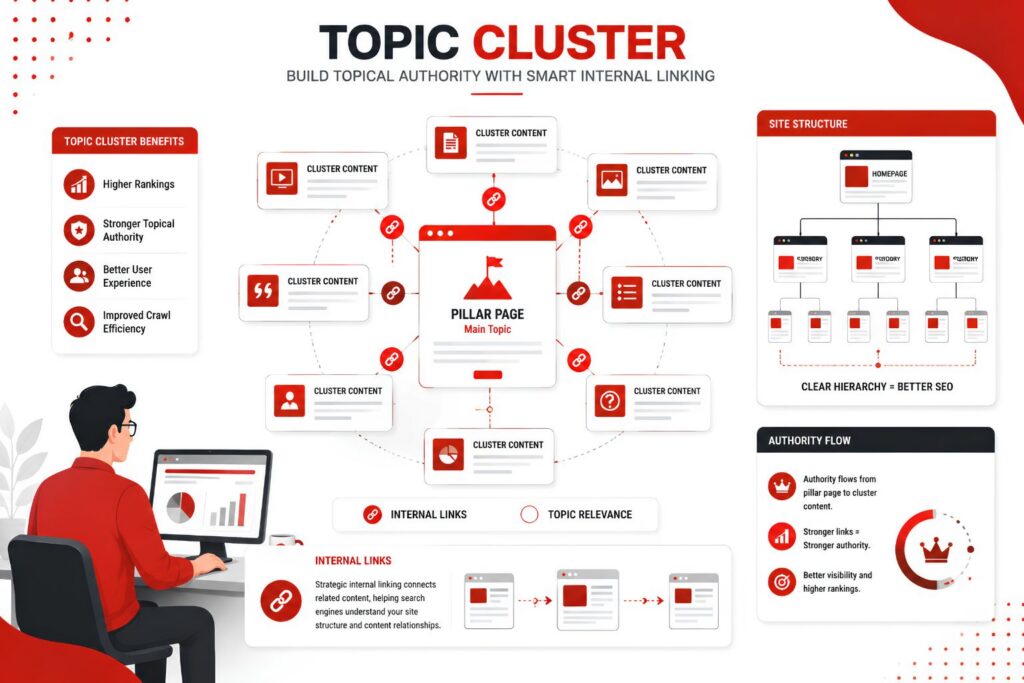
To overcome this, adopt a content clusters strategy. This approach organizes your site into a logical map where a pillar page serves as a central hub, surrounded by supporting sub-pages that answer specific long-tail questions. By linking these pieces intentionally, you create a semantic web that is easy for AI crawlers to navigate. This is about establishing a clear hierarchy of information where every page reinforces the expertise of the others.
Why Structure Matters for Machines
Think of your content as a library. Without a filing system, an AI would find it impossible to locate the right book on a specific subject. By implementing a cluster strategy, you create the index for that library. This structure ensures that AI crawlers see a clear, authoritative map of your site’s knowledge and your brand is consistently identified as the primary source for specific entity relationships.
The Semantic Depth Deficit: Moving Beyond Surface-Level Answers
The semantic depth deficit occurs when content mimics the structure and tone of existing information without adding substantive value. Because AI models are trained on massive, generalized datasets, they naturally default to average responses. When you rely solely on tools to produce material, your site becomes a mirror of the existing web. If your pages merely recycle common definitions, you fail to provide the Experience component of E-E-A-T, which is essential for topical authority.
To overcome this, you must move beyond summarizing publicly available facts. Engines prioritize content that offers unique perspectives, first-hand examples, and proprietary insights. By infusing your strategy with specific, grounded evidence, you transition from a passive content generator to an authoritative voice.
How to Inject Unique Value into Your Content
Focus on elements that ground your narrative in reality. Integrate internal data or case studies that reflect your actual business operations. When describing a process, don’t just list the theory; explain how you’ve implemented it and what challenges you encountered.
- Original Data: If you have run experiments, visualize this data. AI models extract stats backed by verifiable sources.
- Expert Interviews: Quote team members with specific credentials. Giving your content a human face builds immediate Trustworthiness.
- Proprietary Perspectives: Take a stance on industry trends. If the common consensus is flawed, explain why based on your experience.
Diagnosing the Gap: Why Your Content Fails to Build Trust
Even well-researched articles can become invisible to AI models if they aren’t structured to communicate clarity and authority. When scaling content for AI search, the primary hurdle is often the accessibility of your data. If an AI system cannot easily extract, verify, and attribute your content, it won’t use it, leaving your site out of the loop for critical citations.
Identifying Technical Misalignment
The most common point of failure is a disconnect between the visible content and the underlying code. AI crawlers rely on structured data, such as JSON-LD schema, to understand entity relationships. If your text explains a process, but your schema markup is generic or contradictory, the AI engine may experience a confidence drop. Additionally, answer-first formatting failures occur when you bury the key takeaway under long introductions. If your content lacks a concise, 40–60 word summary at the beginning of each major section, you make it harder for the machine to extract a clean, quotable response.
Demonstrating Trust Through E-E-A-T
Beyond technical structure, you must satisfy the E-E-A-T criteria. AI models are trained to prioritize content originating from identifiable, credible entities. If your pages lack clear author credentials, verifiable citations, or transparent publishing dates, the AI might flag your content as low-quality. Ensure every piece of content includes an explicit author byline that links to a detailed bio. Support your claims with links to reputable, primary-source data to build the foundation necessary to be cited as a trusted expert.
Closing the Gap: A Strategy for AI-Ready Authority
Shifting from standard production to authoritative content engineering requires changing how you approach your digital ecosystem. To succeed, stop viewing your website as a static library of pages and start treating it as a dynamic knowledge graph.
Architecting for Machine Clarity
Your technical infrastructure acts as the foundation for E-E-A-T. AI crawlers cannot interpret your expertise if your site structure is ambiguous. You can signal authority by implementing precise JSON-LD structured data. By wrapping your content in schema types like Article, FAQPage, or Organization, you explicitly define what your content represents. Consistent brand voice serves a similar function. When your tone remains uniform across all assets, it strengthens your entity signals. Avoid the temptation to use automated jargon; instead, use clear, entity-rich language that defines concepts concisely.
Balancing Automation with Human Oversight
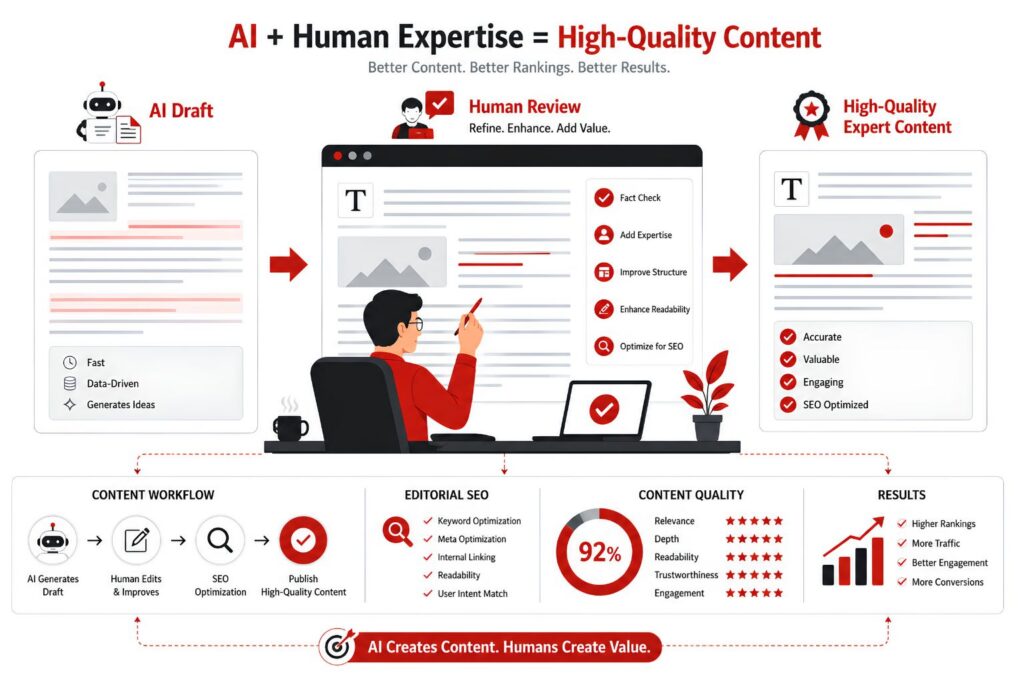
While AI-generated content can increase your output, it risks becoming thin without human oversight. High-value authority requires a blend of automated efficiency and strategic human input. Use AI to handle structural tasks—such as creating comparison tables or draft schemas—but ensure your unique perspective remains central. To maintain trust, conduct regular content audits to remove outdated pages, apply an answer-first approach to every section, and frequently validate your structured data. By layering human-led strategy over automated processes, you ensure your content remains a reliable, high-value asset that builds long-term, defensible trust with search models.
AEO/GEO
Want to learn more?
Contact us for direct consultation and support.