Scaling Content for AI Search: Building Trust and Authority
You have spent weeks producing high-quality content, yet your traffic remains stagnant. Many creators face this familiar cycle: you publish more than ever, but search engines and AI answer engines seem to overlook your work. The issue is not a lack of effort but an elusive barrier known as the Authority Gap.
This gap is the missing link between standard machine-generated text and the influence required for visibility in the modern search landscape. While AI drafts copy at speed, it lacks the verifiable evidence search systems demand to establish trust. Scaling content for AI search requires a strategic pivot toward proving your expertise through clear, structured, and authoritative insights. By understanding how to bridge this gap, you transform ignored content into a trusted resource that answer engines actively cite.
Understanding the Authority Gap in AI Search
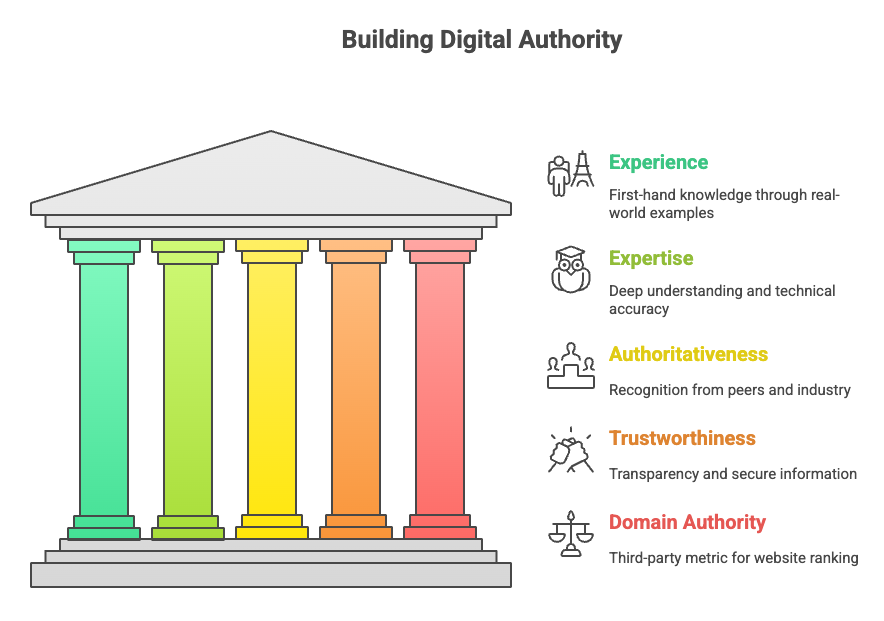
The Authority Gap is the disconnect between the speed of AI-generated content and the E-E-A-T signals (Experience, Expertise, Authoritativeness, and Trustworthiness) that modern search engines prioritize. While AI synthesizes information efficiently, it lacks the Experience component. This gap represents the difference between content that fills a page and content providing firsthand value.
Why AI Mimicry Falls Short
Modern answer engines like Perplexity or Google AI Overviews are highly selective with citations. Unlike traditional search, which focused on keyword density, AI systems evaluate information credibility. Relying solely on AI to produce text creates generic output lacking the case studies, original data, or real-world applications that models use to verify expertise.
To bridge this gap, you must pivot from high-volume production to depth-first creation. AI models naturally gravitate toward sources demonstrating clear evidence of firsthand knowledge. If your content only summarizes existing web information, it offers no source of truth for the engine to cite.
| Feature | AI-Only Content | Expert-Driven Content |
|---|---|---|
| Primary Value | Speed and volume | Original insights and data |
| Trust Signal | Weak; generic synthesis | Strong; verified through E-E-A-T |
| Citation Potential | Low; often overlooked | High; cited as a trusted source |
| User Impact | Surface-level information | Actionable, high-trust guidance |
| Search Engine View | Commodity text | Specialized reference material |
Moving Beyond Volume to Topical Authority
In the era of AI-driven search, the “more is better” mantra has become a liability. Scaling content for AI search is about establishing topical authority through precision and accuracy. AI models are programmed to synthesize reliable information, meaning superficial content is ignored in favor of comprehensive resources that satisfy complex queries.
The Power of the Trust Chain
To earn a spot in an AI-generated answer, your content must possess a clear Trust Chain. This is the mechanism by which search engines and LLMs verify the credibility of your claims. Every assertion should be backed by primary sources, expert insights, or original data. Constructing this chain provides the reasoning the AI needs to cite you as an expert source.
AI as the Research Assistant, Not the Author
A significant mistake in modern content strategy is treating AI as an automated writing factory. Instead, use AI as a research assistant. Utilize these tools to organize large datasets or summarize research, but keep editorial control in human hands. You provide the experience; let the AI handle the data-heavy tasks.
Actionable Steps to Bridge the Gap with E-E-A-T
Building E-E-A-T is essential when scaling content for AI search. AI models prioritize reliable information to protect their reputations, requiring signals that prove a human expert is behind the content.
Infusing Human Experience
While AI tools generate the bulk of a draft, they cannot replicate lived experience. Inject human elements into your workflows:
- Proprietary Data: Include unique insights, internal survey results, or platform data.
- Original Media: Replace stock photography with screenshots of your processes, tools, or results.
- Personal Anecdotes: Add specific stories about challenges your team solved or lessons learned.
Establishing Credible Author Entities
For LLMs to trust your content, they must verify the creator. Set up dedicated author bio pages including professional credentials and industry affiliations. Reinforce this by implementing JSON-LD structured data using Person or Organization schema markup. This provides a machine-readable digital business card that tells crawlers exactly who you are.
Optimizing for AI-Ready Authority
Scaling content for AI search requires technical adjustments to ensure LLMs can easily ingest your expertise.
- Answer-First Pattern: AI agents prioritize concise, self-contained blocks of text. Lead each major section with a 40–60 word definitive answer.
- Render Readiness: Ensure primary content is hardcoded into the HTML. If the model cannot read the text during its initial pass due to reliance on JavaScript, it cannot cite you.
- Robots.txt Management: Audit your robots.txt file to ensure AI crawlers like GPTBot and Google-Extended are not blocked.
By combining the speed of AI with your unique perspective and verified credentials, you transform your site into a reliable source of truth. The future of search is about being the trusted entity that AI systems rely on to inform the world.
AEO/GEO
Want to learn more?
Contact us for direct consultation and support.