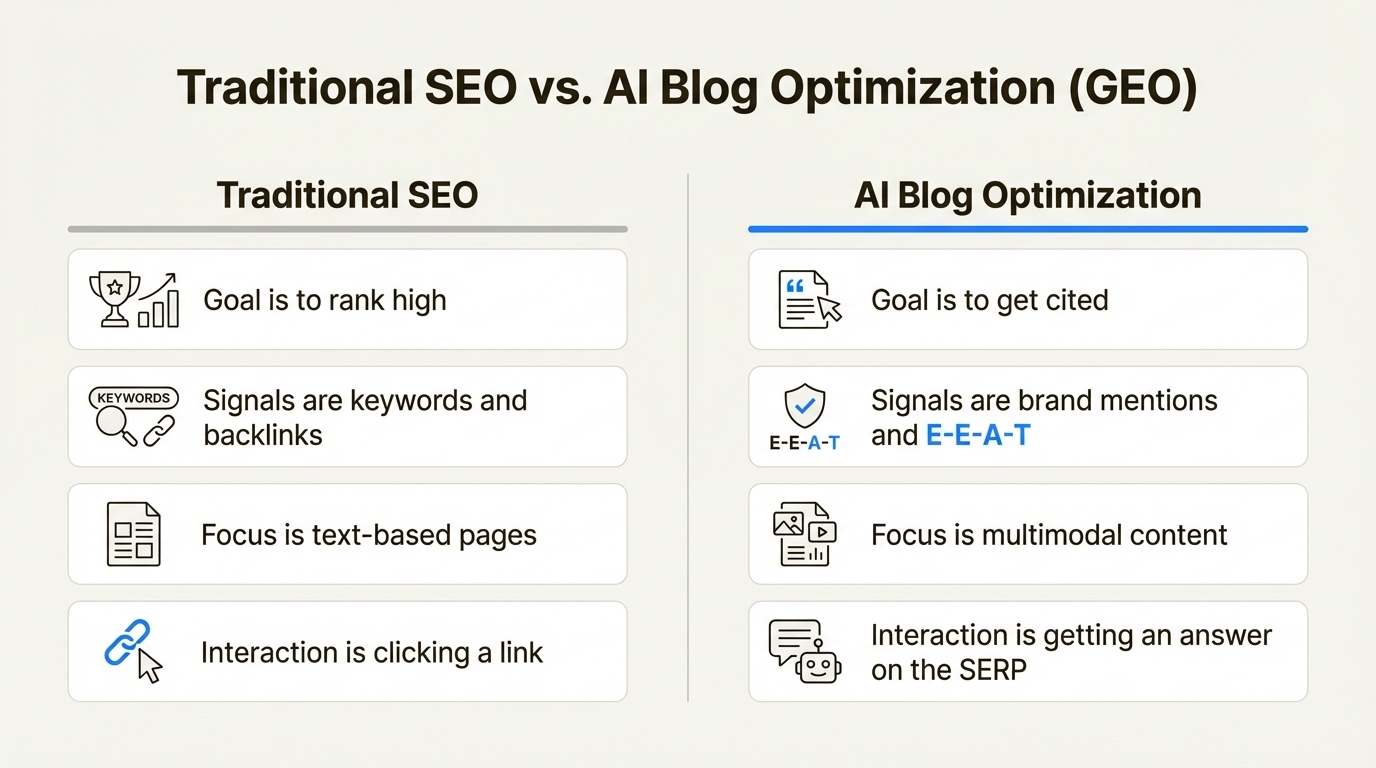
To dominate in the age of generative search, you must stop writing for human readers alone and start engineering for AI-readiness. This playbook outlines a tactical, developer-style approach to Generative Engine Optimization (GEO).
The GEO Gap Analysis: Stress-Testing Your Content Against AI Search Performance
Stop guessing why you aren’t appearing in AI summaries. Perform a side-by-side gap analysis by comparing your top-performing articles against the current AI-generated answers for your target queries.
- Extract the AI Answer: Query your primary keyword in multiple LLM-based search tools. Copy the AI’s synthesis into a spreadsheet.
- Citation Benchmarking: Map the AI’s answer to your existing content. Are you cited? If not, what sources were used instead?
- The Readiness Audit: Create an “AI-Readiness Score” from 1-10.
- Low Score (1-4): Contains “fluff” or generic advice with no data, original research, or primary sources.
- Mid Score (5-7): Covers the topic well but lacks clear, extractable definitions or structured data.
- High Score (8-10): Contains clear definitions, data-backed claims, and primary source links.
- Identifying Content Debt: Flag sections of your site that contain “content debt”—outdated statistics, recycled generalities, or long-form paragraphs that lack a specific anchor point. If an AI cannot cite your text to answer a “what” or “how” question, that section is underperforming.
Engineering for Snipability: Technical Rules for Content Reformatting
AI models favor content that acts as an “answer-first” database. If your content forces the model to synthesize through fluff to find the core answer, you lose the snippet.
- The 200-Word Rule: Every core concept must be defined within the first 200 words of the page. Do not bury the answer in a long introduction.
- Machine-Readable Hierarchies: Use clear
H2andH3headers that act as natural language questions. If your header is “Our Methodology,” change it to “How We Audit Content for AI Readiness.” - Answer-First Clarity: Rewrite existing paragraphs to start with the direct answer, followed by the supporting evidence.
- Bad: “Many companies have tried to optimize for AI, but it is difficult because of the technical overhead…”
- Good: “Optimizing for AI search requires three technical pillars: semantic structured data, citation-heavy attribution, and concise answer-first formatting.”

Injecting Credibility: Replacing Generic Claims with Hard Citations
Generative AI prioritizes high-confidence, verifiable information. Generic advice gets ignored; cited facts get pulled into the answer.
- Anatomy of a Snipable Sentence: Every claim should be structured as: [Specific Metric/Action] + [Contextual Data/2024 Reference] + [Primary Source Link].
- Transforming Weak Claims: Audit your site for phrases like “Studies show…” or “Industry experts agree…” and replace them with specific links: “According to a 2024 report by [Organization], [Specific Metric] improved by [X]% when using [Technology].”
- Standardizing Attribution: Build a standardized citation footer or in-line attribution style. When you cite a primary source, use clear, descriptive anchor text that includes the entity name to help the AI link your content to established knowledge graphs.
The Iterative Optimization Cycle: Tracking and Refinement Methodology
Content in the AI era is a living product. You cannot “publish and forget” and expect to remain in the top position.
- The Decay Threshold: Set a review cadence based on your niche’s volatility. For SaaS, review core pages every 90 days. If your search visibility in LLMs drops, your content has likely hit its “decay threshold” and requires fresh data.
- Living Document System: Maintain a master spreadsheet tracking the primary generative search results for your core terms. Link the current “AI Winner” to your tracking sheet for recurring competitive intelligence.
- Continuous Improvement Loop:
- Monitor: Review AI-cited sources weekly.
- Update: Inject one new, verifiable piece of data or case study per cycle.
- Refine: Trim unnecessary prose to keep the “answer-first” density high.
- Repeat: Test the updated version in the AI search tool to confirm if your citation status improved.