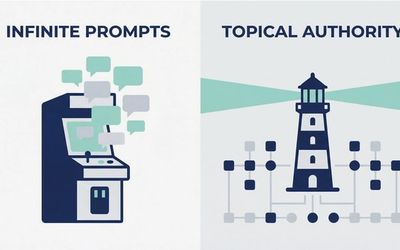
The Shift: From Keyword Ranking to Answer Engine Authority
The fundamental challenge of modern SEO lies in the transition from blue-link competition to generative synthesis. AI search engines—such as Perplexity, Google SGE, and OpenAI Search—do not prioritize static keyword lists; they prioritize the retrieval of the most authoritative, synthesized information to construct direct answers.

In this ecosystem, traditional rank-tracking metrics are insufficient. Success is now defined by citation frequency and the ability to be identified as the source of truth within an AI snapshot. To achieve this, brands must shift their focus toward building topical authority using a hub-and-spoke content architecture. This methodology organizes your content to mimic the way large language models (LLMs) categorize information, ensuring your site acts as a definitive knowledge base that AI agents can confidently reference.
Structural Design: Building AI-Ready Content Clusters
To signal hierarchy to AI crawlers, you must move away from isolated, high-volume keyword targeting. Instead, organize your library into dense, thematic clusters.
- Pillar Pages: Create high-level foundational pages that define core industry topics. These pages should be broad enough to capture high-intent searches while serving as the anchor for your entire cluster.
- Satellite Content: Develop targeted, long-tail articles that dive deep into specific variations of the core topic. These satellites address niche questions and satisfy the “deep dive” requirements of generative search models.
- Structural Internal Linking: Your internal link architecture is critical. Every satellite page should link back to its corresponding pillar page, and the pillar page should explicitly link out to its satellite content. This explicit connection creates a clear knowledge graph that allows AI models to map the relationships between your concepts and establish your brand as an expert in the broader category.

Tactical Implementation: Creating Machine-Readable Depth
AI ingestion requires more than just keywords; it requires data-backed clarity. Models prioritize content that is structured for immediate extraction, minimizing the risk of hallucination by citing dense, factual sources.
- Data-Driven Formatting: Use tables, clearly labeled lists, and hierarchical headings to present your findings. This structured format makes it easier for LLMs to extract snippets directly for user summaries.
- E-E-A-T Signaling: Incorporate Experience, Expertise, Authoritativeness, and Trustworthiness markers directly into your content structure. Use verified author bios, cite primary data sources, and provide transparent links to research papers to boost your content’s credibility score.
- Direct Answer Blocks: At the beginning of each section, provide a succinct, one-to-two-sentence summary that answers the anticipated user query. This ensures your content is pre-optimized for inclusion in generative AI snapshots.
Operationalizing Success: Monitoring and Maintenance KPIs
Visibility in generative search is not a set-it-and-forget-it goal. Because AI training data and user query intent evolve, you must treat your content as a dynamic product.
- Generative KPIs: Move beyond standard traffic metrics. Focus on citation rate—how often your brand is mentioned in AI-generated answers—and model perception scores, which track how consistently your content is favored by various search interfaces.
- Quarterly Refresh Cycle: Implement a consistent review process to audit for “content decay.” If your data, industry references, or technical claims become outdated, AI models will deprioritize your content in favor of fresher, more accurate data sources.
- Decay Auditing: Regularly test search queries through multiple AI platforms to verify if your content remains the cited authority. If a competitor has surfaced as the primary source, identify the information gap in your satellite content and update it immediately to reclaim your authority position.",contentInsight:[{content: