The Paradigm Shift: From Ranking Pages to Supplying Passages
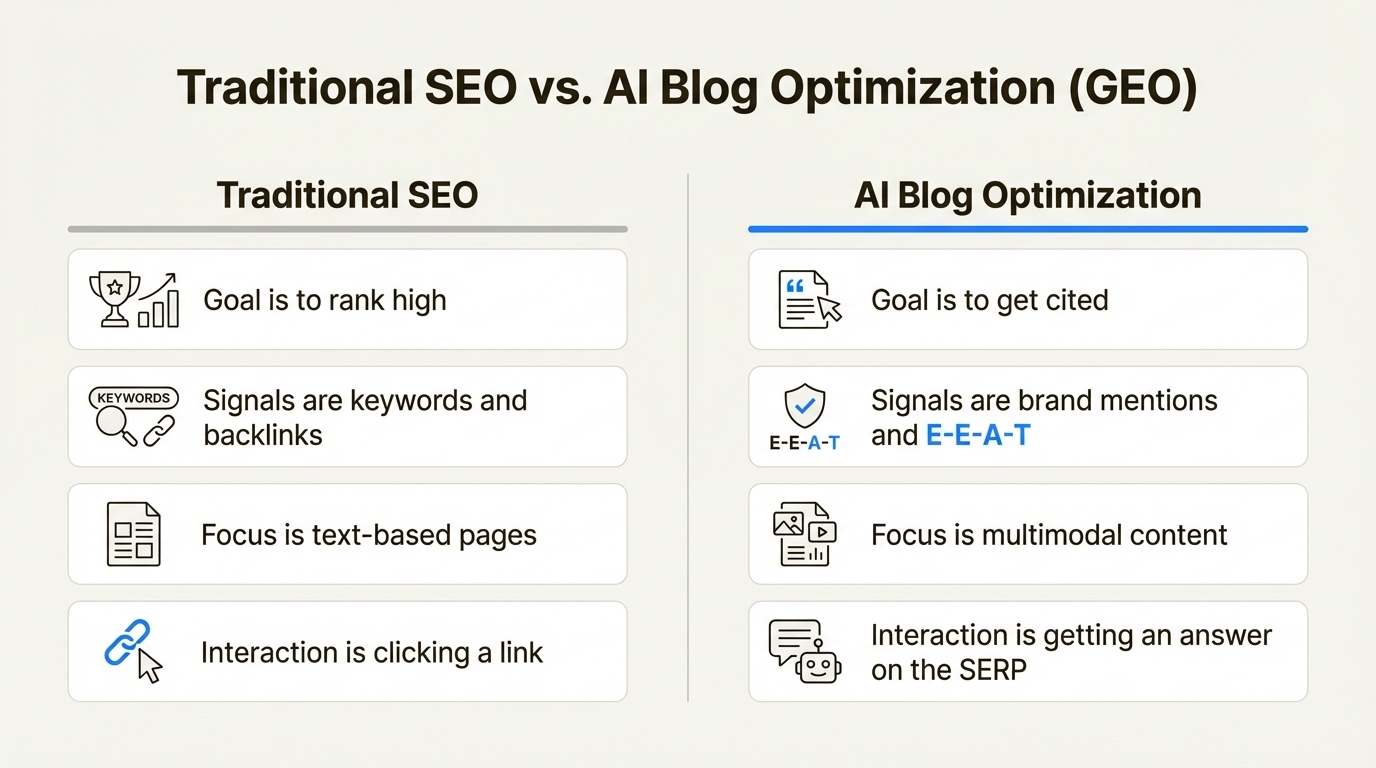
The traditional SEO model, centered on securing a top-ten spot on a search engine results page (SERP), is rapidly losing its relevance. In the era of generative AI, users no longer click through a list of blue links to aggregate their own findings; they receive synthesized, comprehensive answers generated by Large Language Models (LLMs). This shift demands a move away from optimizing for link-based rankings toward optimizing for Retrieval-Augmented Generation (RAG).
RAG is the underlying mechanism that allows AI models to “read” your content in real-time, retrieve the most pertinent facts, and synthesize them into a coherent answer. Unlike old-school keyword stuffing, success here hinges on information gain—the unique, high-value data points you provide that an AI cannot easily replicate from generic sources. To win in this new environment, you must stop thinking of your website as a collection of pages and start treating it as a highly curated knowledge repository.
The 3 Pillars of AI Search Visibility: Parseability, Chunkability, and Citability
To ensure your content is favored by generative search engines, you must architect it according to three technical principles:
- Parseability: This is your content’s technical accessibility. Ensure your site uses clean, semantic HTML5, clear heading hierarchies, and machine-readable data. If an AI cannot easily parse your underlying structure, it cannot extract your information accurately.
- Chunkability: LLMs process information in “chunks”—discrete, self-contained units of knowledge. Designing your content with atomic, highly focused sections makes it easier for retrieval systems to isolate the exact answer a user is looking for, increasing the probability of your content being selected.
- Citability: Trust is the currency of the AI era. You must implement robust schema markup and explicit source attribution throughout your content. By providing clear meta-data and verifying sources, you signal to AI models that your content is an authoritative, trustworthy reference.
Applying the Inverted Pyramid for LLM-Ready Content Architecture
The classic journalism technique known as the Inverted Pyramid—placing the most critical conclusion or answer at the very beginning—is now the gold standard for generative search.
Modern LLMs are programmed to prioritize efficiency. When an AI retrieves your content, it often weighs the first few sentences of a section most heavily. By front-loading the “answer” to a query and following it with supporting context, you maximize your chances of being featured in a generated summary. This strategy balances the need for high information density with natural readability, ensuring that both human readers and AI models find immediate value in your work.
The CMS as the Backbone of Your RAG Pipeline
Your Content Management System (CMS) is no longer just a publishing interface; it is the infrastructure for your brand’s AI presence. To effectively participate in generative search, your CMS must facilitate the creation of structured metadata and JSON-LD.
Semantic labeling acts as the bridge between human-readable narratives and machine-understood intent. When you label your content with precise, context-rich metadata, you effectively “teach” the AI about the relationships between your concepts, services, and expertise. Transforming your CMS into a structured data source is the single most effective way to improve your retrieval confidence across the board.
The AI Search Visibility Audit Checklist
To maintain a competitive edge, perform a regular audit to ensure your content remains optimized for AI consumption.
- Verify Semantic Clarity: Use diagnostic tools to ensure your H-tags follow a logical, hierarchical order that clearly defines your topic structure.
- Audit Schema Integrity: Check that your JSON-LD and schema markup are properly implemented to maximize the chance of being cited by AI models.
- Measure Citability: Monitor how frequently your brand and specific content URLs are appearing in generative search responses.
- Information Gain Review: Assess your content to ensure it provides unique insights or data that distinguishes your brand from competitors, ensuring the LLM has a reason to cite your specific passage over others.
- Atomic Consistency Check: Ensure every sub-section is a self-contained unit of truth, capable of standing alone when retrieved by a search bot.