The Geographic-Context Imperative in AI Search
In the evolving landscape of generative search, geographic relevance has transcended simple local SEO. AI models now treat geographic signals as fundamental trust markers, using them to calibrate the perceived reliability of an information source.
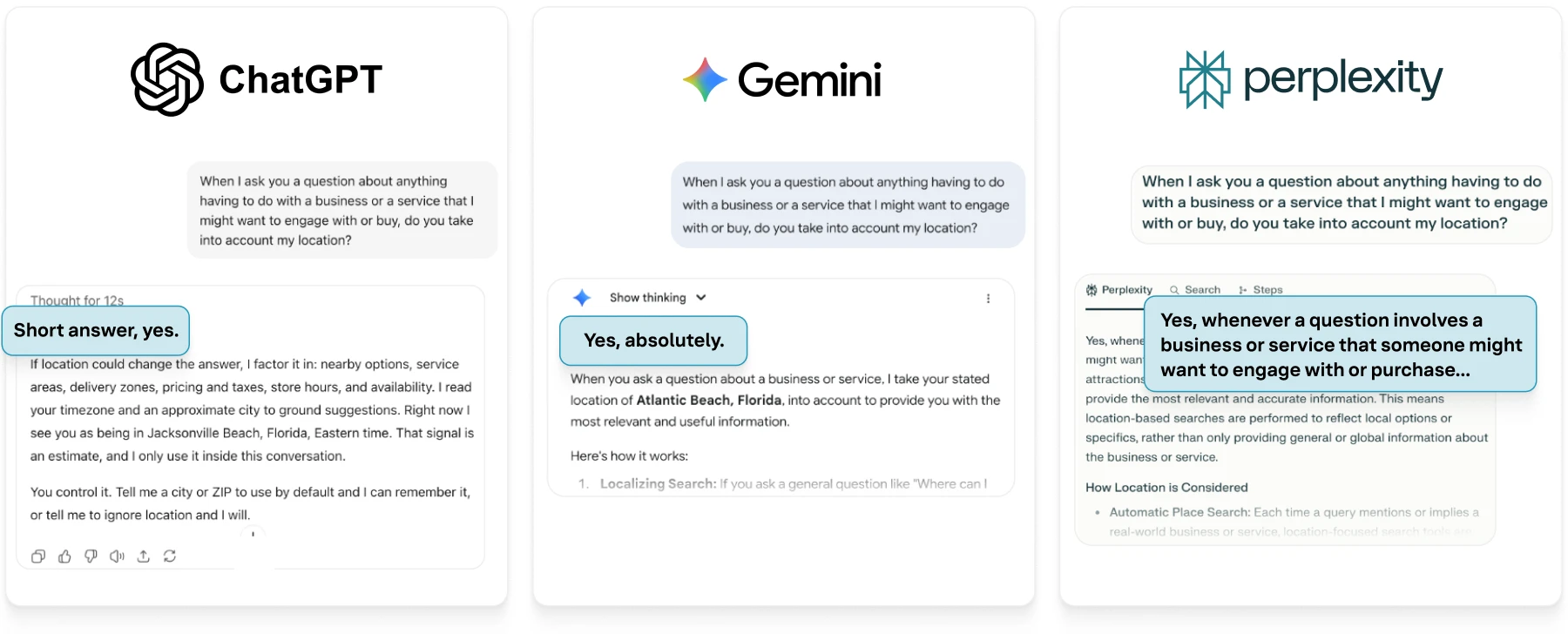
Generative models prioritize data that aligns with a user’s physical or regional context. This relies on the Distance-to-Query principle, where the AI assesses the proximity between the user’s intent and the physical location of the business or the service area defined in the content. When this distance is minimized, the AI’s confidence in presenting that content as a primary source increases significantly.
To capitalize on this, brands must move beyond explicit location tags. Instead, weave geographic signals directly into unstructured content through natural language that anchors service offerings, regulatory insights, or regional case studies to specific spatial coordinates. By consistently mapping your expertise to location-specific challenges, you prime AI models to prioritize your assets for region-centric queries.
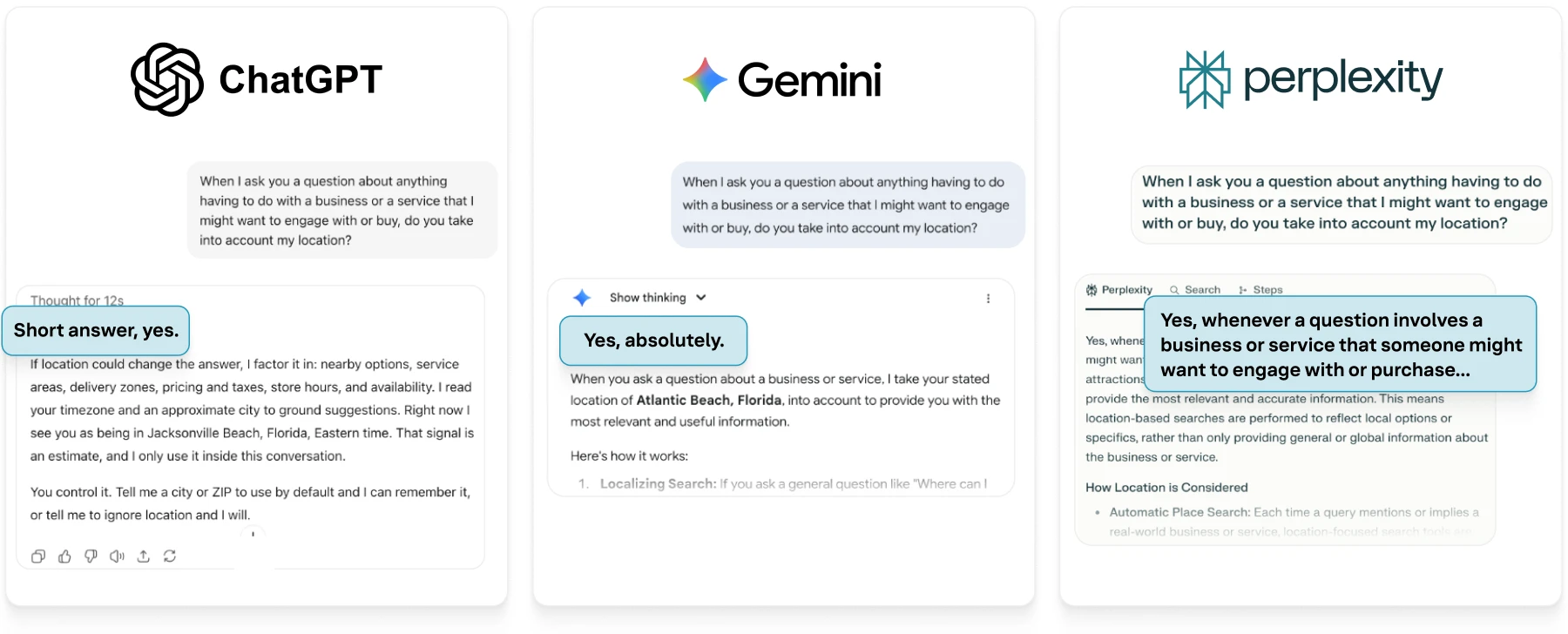
The Control Framework: Categorizing Your Citation Footprint
Not all web signals carry equal weight in generative retrieval. To optimize your footprint, you must categorize every asset you own or influence using the four-tier Control Framework. This strategy allows you to predict the reliability of AI retrieval based on where your content lives.
- Full Control: Assets residing on your primary domain, such as your knowledge base, technical documentation, and service pages. These are your most reliable assets for exact fact retrieval.
- Controllable: Platforms where you manage the identity and primary content, such as verified social profiles, business listings, or official industry partnerships.
- Influenced: External sites, guest posts, or industry forums where you provide input but do not dictate the final publishing environment.
- Uncontrolled: Third-party reviews, mentions, or social discourse that you cannot modify but must monitor for sentiment and topical accuracy.
The objective is to aggressively migrate key messaging from “Uncontrolled” and “Influenced” buckets into “Full Control.” By centering your core value propositions within your own ecosystem, you provide the AI with a single, verifiable “Source of Truth” that it can confidently cite.
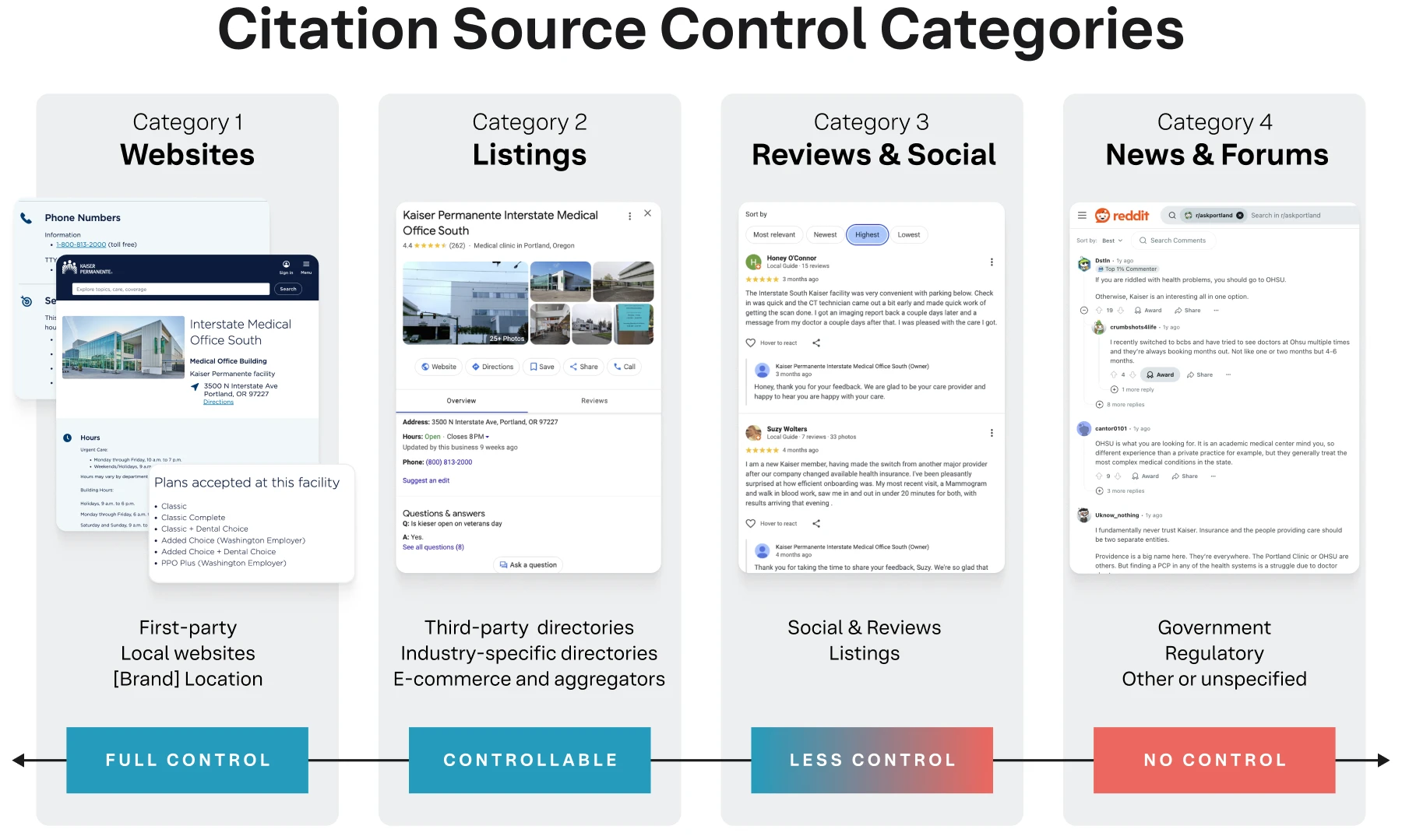
Query Classification Framework (QCF): Aligning Content to Intent Signals
Visibility gaps often stem from a misalignment between content formatting and user intent. Different AI engines map specific search intent to distinct source categories, necessitating a shift away from keyword clusters toward a Query Classification Framework (QCF).
The QCF requires you to diagnose your content based on the intent it fulfills. For instance, a technical white paper functions differently than an opinion-led blog post in the eyes of an LLM. When an AI receives a navigational, informational, or transactional query, it hunts for specific source types:
- Instructional Intent: Maps to structured documentation and how-to guides.
- Evaluative Intent: Maps to data-driven comparative assets and case studies.
- Conversational Intent: Maps to expert-led thought leadership and synthesized insights.
By auditing your library against these intent classifications, you can bridge visibility gaps. If your site lacks the high-intent “Proof Assets” required for competitive categories, no amount of keyword optimization will force an AI citation.
Differentiating Visibility Tactics Across AI Ecosystems
The AI landscape is not a monolith. Google’s SGE, OpenAI’s SearchGPT, and Perplexity utilize distinct retrieval mechanisms and weighting algorithms. Attempting a “one-size-fits-all” approach to citation optimization is fundamentally flawed.
- Google SGE: Heavily weights traditional authority metrics, site stability, and schema-structured data.
- OpenAI/Perplexity: Focus more on conversational coherence and the density of “Proof Assets” (data-heavy, original research) found within the source context.
Successful brands must adapt their Proof Assets based on the dominant models their target audience uses. This involves multi-modal optimization—ensuring that your core arguments are expressed in text for retrieval, while supporting data is formatted in clean, machine-readable tables or bulleted structures that AI models can easily parse during the synthesis process.
Operationalizing GEO: From Diagnostic to Execution
Winning visibility in generative search requires an ongoing, measurement-driven feedback loop. Start by establishing a baseline using the Control Framework: track where your citations are currently originating and whether they align with your “Full Control” assets.
- Audit: Identify which intents your current content fails to address and where your geographic signals are weak.
- Refine: Pivot your content production to focus on high-intent categories, ensuring every piece of content is anchored to relevant geographic contexts.
- Measure: Track how your brand’s citation frequency increases as you successfully move assets into your internal “Full Control” ecosystem.
By treating visibility as a technical output of geographic relevance and source control, you transform your brand from an passive participant into a primary architect of the AI-driven search experience.