AI Content Strategy for the AI Era: Mapping Logic to LLMs
You have spent years building a digital library, pouring expertise into hundreds of articles, only to find that your traffic is shifting. Instead of visitors clicking through to your site, AI search tools are summarizing your insights and presenting them as their own, often stripping away the context that makes your brand unique. This is a fundamental mismatch between how you wrote your content and how Large Language Models digest information.
Most legacy content is optimized for human eyes and keyword-matching bots, yet LLMs function by constructing vast, interconnected webs of facts. When your content lacks internal structural clarity, these models struggle to map your expertise onto their knowledge graphs. You don’t need a complete overhaul to fix this. By adopting an AI Content Strategy for the AI Era, you can stop chasing algorithmic updates and start mapping your logic to the way machines learn.
The Shift from Keyword Density to Content Logic
For years, success in search was measured by how often you could weave a specific term into a page. Traditional search indexing functioned like a massive library index, categorizing pages based on frequency and proximity. Large Language Models have changed this dynamic. Modern AI processes information by mapping data into complex LLM Knowledge Graphs.
These models view content as a collection of entities—people, places, concepts, and technical processes—and search for the relationships between them. If your legacy content is built on repetitive keywords rather than structured relationships, the AI struggles to verify the truth of your information. This effectively renders your hard work invisible to generative answers.
Defining Content Logic
To thrive, you must transition your focus to Content Logic. This is the clear, hierarchical expression of a concept that makes it effortless for an AI to parse, categorize, and link to other verified facts. Think of it as an instruction manual for the AI. Instead of burying answers in flowery prose, Content Logic prioritizes clarity, precise definitions, and logical progression.
When you build content with strong logic, you are creating nodes in a knowledge graph. This makes your brand a reliable source for the AI to cite, as the model can easily extract a definitive answer from your structure, reducing the likelihood of hallucination.
Is Your Content AI-Readable? A Diagnostic Checklist
Use this checklist to audit your existing pages and identify which ones require immediate attention to improve their AI Indexing potential:
- Entity Clarity: Does the primary topic appear within the first two sentences? Does the text define the entity in a way that distinguishes it from similar, ambiguous terms?
- Logical Flow: Does the article follow a modular structure? An AI finds it easier to parse content that uses a “Main Premise -> Supporting Evidence -> Practical Example” flow.
- Factual Density: Does the page contain actionable data or unique insights? AI models prefer content that provides concrete answers over fluff.
- Semantic Relationships: Are you referencing related concepts that explain how one topic connects to another? Stronger connectivity helps the model build a richer map of your brand’s authority.
Diagnostic Prioritization: Where to Focus Your Efforts
Your existing content library is a goldmine, but not every piece holds the same value in an AI-driven search ecosystem. To build a robust strategy, you must stop treating archives as a flat list and start viewing them through the lens of data utility.
Categorizing Your Assets
Begin by sorting your content into two primary buckets: High Citation Probability and Low Value. High Citation Probability assets are those that contain unique research, proprietary data, or comprehensive original analysis. LLMs are trained to favor factual, dense information. Conversely, Low Value assets often consist of outdated advice or thin content that mirrors information already ubiquitous across the web.
The Decision Matrix for Content Remediation
Use a decision matrix to determine the action required for Repurposing Legacy Content.
| Action | Topic Authority | Current AI Visibility | Model Alignment |
|---|---|---|---|
| Update | High | Low/Medium | High |
| Merge | Medium | Low | Medium |
| Archive | Low | Low | Low |
When evaluating these factors, consider your Topic Authority as the depth of expertise shown. Current AI Visibility refers to whether an LLM pulls information from this page during a query. Model Alignment looks at how well the tone and structure match the direct, factual preferences of modern search engines.
Reframing Legacy Assets: The Semantic Reformatting Process
Transforming your library into a resource that LLMs crave is about restructuring your Content Logic to mirror how machines process information. By reformatting content into structured knowledge blocks, you lower the energy cost of ingestion, which improves your chances of being cited.
The Definition-First Protocol
The most impactful change you can make is the implementation of a “Definition-First” approach. AI models prioritize the beginning of a document. Instead of starting with a storytelling hook, start with a precise, declarative definition. A simple pattern like “[Term] is [Primary Function] that helps [Target Audience] achieve [Specific Outcome]” provides the LLM with a ready-made snippet it can pull directly into a summary.
Modularizing Content into Knowledge Blocks
Break down dense paragraphs into discrete knowledge blocks. Strip away filler transition phrases and excessive padding. Use clear, descriptive headings that function as semantic labels. Each section should focus on one single concept or step. Use bulleted or numbered lists for procedural information, as these are easier for models to parse into sequential steps.
Leveraging Fact Tables for AI Citation
While humans often skim past data tables, AI models treat them as high-density information goldmines. By converting narrative comparisons into structured tables, you create a direct path for the AI to extract and present your data accurately.
| Feature Category | Legacy Approach | AI-Ready Approach |
|---|---|---|
| Information Density | Paragraphs | Tables/Lists |
| Entity Linking | Implicit | Explicit |
| Citation Probability | Moderate | High |
Follow these tables with a “Contextual Summary”—a 50-word wrap-up that highlights why these facts matter. This combination of raw, structured data and high-level context creates the perfect ecosystem for AI citation.
Measuring Citation Probability and Long-Term Authority
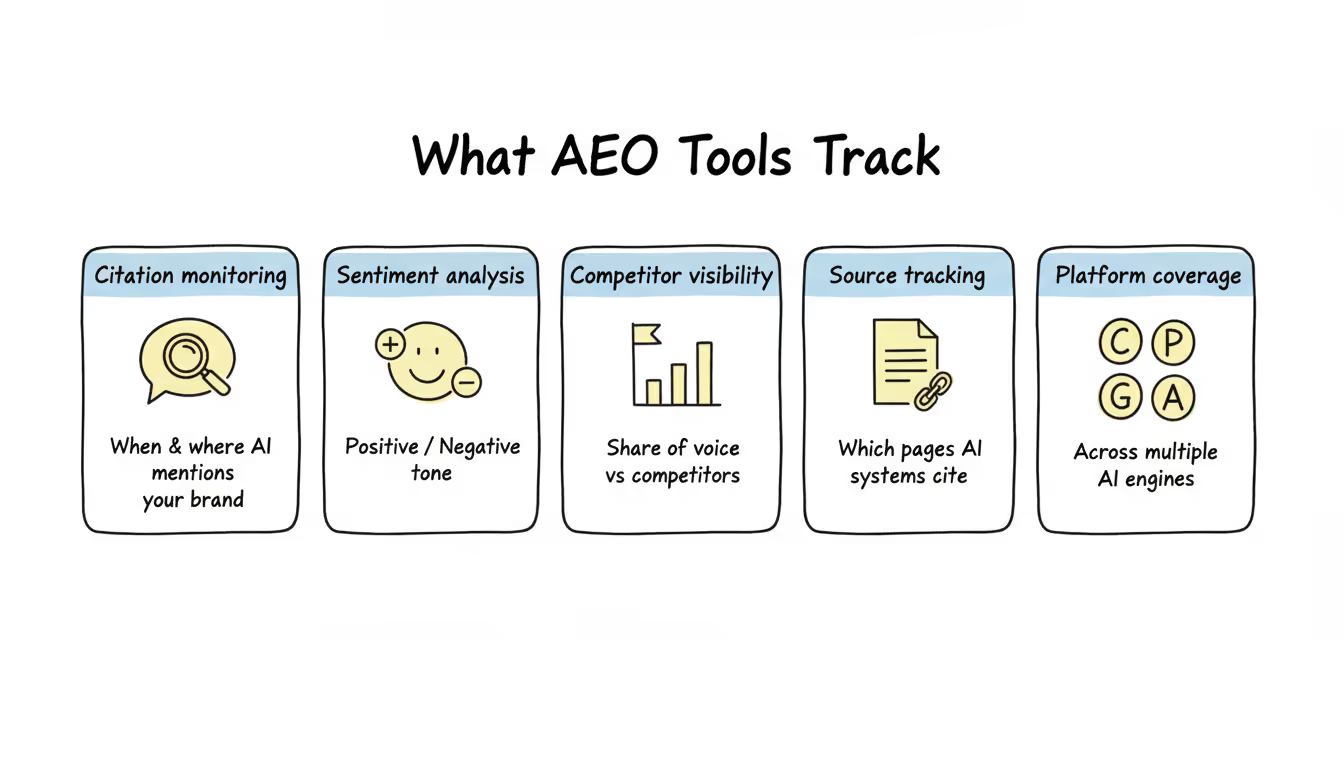
To succeed in an AI Content Strategy for the AI Era, shift your focus toward Citation Rate and AI Brand Sentiment. These metrics track how often AI models identify your content as the authoritative answer for specific queries.
Tracking Your AI Footprint
Actively test how LLMs handle your industry topics. Use tools like ChatGPT or Perplexity to run diagnostic prompts. Ask, “What are the top three approaches to [your specific industry problem]?” and observe if the model cites your brand. If your content is structured correctly, the AI will pull your definitions and data points directly into its response.
Building this digital ecosystem isn’t about overhaul; it’s about strategic refinement. When you frame your existing assets through the lens of machine readability, you stop competing for fragments of attention and start owning the authoritative answers that shape user decisions. Start this week by auditing your top five highest-traffic legacy pieces and applying these logical structure standards.
AEO/GEO
Want to learn more?
Contact us for direct consultation and support.