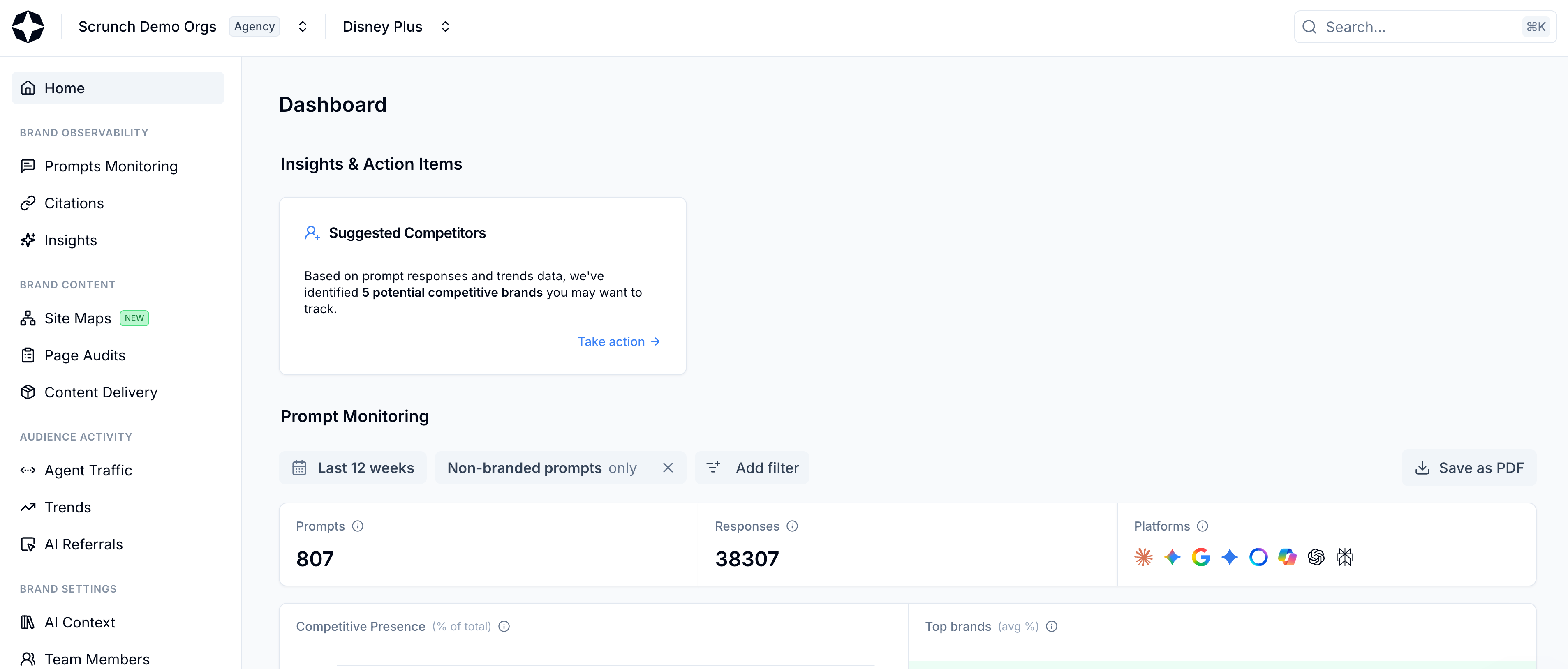
To win in the age of generative search, organizations must treat AI visibility as a measurable, high-stakes engine. Relying on legacy metrics is no longer sufficient; you need a tactical command center to monitor and optimize how your brand is surfaced in AI-driven answers.
The Anatomy of AI Visibility: Essential KPIs for the Generative Era
In generative search, success is defined by how effectively your brand integrates into machine-generated responses. To manage this, you must distinguish between these critical metrics:
- Coverage: The breadth of topics or queries where your brand is identified as a relevant authority by AI models.
- Mentions: The raw frequency of your brand name appearing in AI-generated answers.
- Citations: Instances where the AI explicitly references your content, providing a direct path to your digital property.
- Sentiment Scoring: A qualitative layer that categorizes AI mentions as positive, neutral, or negative, providing context to your brand’s reputation within the model.
- Share of Voice (SOV): Your brand’s prominence relative to competitors within the specific AI responses generated for your target industry keywords.
Building Your Measurement Workflow: From Manual Audits to Automated Alerts
Moving from reactive observations to active command-and-control requires a structured operational workflow.
The Hybrid Monitoring Approach
Use a combination of high-frequency automated alerts for core product terms and periodic manual audits for deep-dive category research.
- Daily Pulse: Automated alerts for top-priority brand and competitor keywords to detect sudden shifts in AI narrative.
- Monthly Audit: Deep-dive analysis of citation sources to ensure accuracy and high-authority backing.
- Quarterly Review: Strategic recalibration of your entity mapping and content pillars based on long-term sentiment trends.
Maintain a central Workflow Documentation Template to ensure your marketing team consistently tags mentions and logs AI response behavior across multiple engines (e.g., ChatGPT, Claude, Perplexity).
Tooling Evaluation: A Comparative Matrix for AI-Ready Brands
Selecting the right stack is critical for aggregating data across fragmented AI ecosystems.
| Capability | Manual/Spreadsheet | Enterprise AEO Platforms |
|---|---|---|
| Alerting | Reactive/Manual | Real-time automated |
| Sentiment Analysis | Highly subjective | NLP-driven (scalable) |
| Data Consolidation | Time-intensive | Unified dashboard |
| Entity Mapping | Fragmented | Advanced tracking |
Selection Criteria: Prioritize platforms that offer cross-platform sentiment tracking, automated entity association reporting, and the ability to distinguish between high-intent and generic brand mentions.
Sentiment Analysis: Moving Beyond Simple Brand Mentions
A brand mention is only as valuable as the context in which it appears. If your brand is mentioned alongside negative industry tropes, your visibility may actually hurt your market position.
- Contextual Tagging: Use automated tools to analyze the text surrounding your brand name in AI responses.
- Sentiment Shifts: Monitor how sentiment changes after product launches or PR events to gauge the AI’s alignment with your desired brand narrative.
- Content Adjustment: If sentiment trends negatively, trigger an immediate audit of your web properties to ensure they clarify the context the AI is misinterpreting.
Benchmarking for Growth: Industry Data and Real-World Outcomes
B2B SaaS companies typically see the highest ROI when moving from 5% to 20% SOV in their niche categories.
Case Study Snapshot: A SaaS firm in the data analytics space identified that they were frequently cited in neutral contexts, but lacked authoritative citations in “best of” comparison lists. By adjusting their documentation to specifically address the comparative framework used by LLMs, they increased their high-authority citation rate by 40% over six months, leading to a 15% uptick in direct, high-intent traffic.
Execution Checklist: Scaling Your Brand’s Presence in AI Search Ecosystems
Transitioning to aggressive optimization requires disciplined, ongoing maintenance:
- Immediate: Establish your baseline SOV for your top 20 industry keywords.
- Weekly: Review sentiment reports; address any misaligned entity associations.
- Monthly: Update content assets that failed to gain traction or citations in the previous cycle.
- Quarterly: Re-evaluate your competitive positioning and adjust your entity mapping to reclaim SOV from rivals.
By treating AI visibility as a precision engine rather than a mystery, you gain the ability to proactively shape how AI models present your brand to the world.