The Shifting Landscape of Customer Connection
The way people spend their time, make purchases, and expect service has changed dramatically. Recent advancements in artificial intelligence have accelerated these shifts, altering how information is shared and consumed. Yet, amidst this technological evolution, one fundamental truth remains constant: the importance of human connection.
AI technology offers powerful tools for content creation and automation. Platforms like HubSpot have integrated features such as Content Assistant and ChatSpot, which leverage large language models similar to OpenAI’s ChatGPT. These tools are packaged directly within business portals, making advanced capabilities accessible. However, technology alone does not guarantee success. The businesses that thrive are those that use these tools to deepen relationships, not replace them.
At HubSpot, the top 20% of growing customers are referred to as “Connectors.” These companies prioritize forging deep customer connections as a core part of their growth strategy. They understand that meaningful engagement is not just a buzzword. It is a powerful catalyst for sustainable growth and lasting relationships.
.png)
This perspective is particularly relevant for businesses navigating the transition to AI-driven search and content ecosystems. As decision-makers in service industries and healthcare sectors evaluate their digital strategies, the question becomes: how do we balance automation with authenticity? The data suggests that the answer lies in using technology to amplify connection, not diminish it.
Data-Driven Insights on Growth and Connection
To understand the impact of customer connection, HubSpot’s Product Analytics team conducted a comprehensive study. The goal was to determine how using their platform helps customers grow. With a dataset spanning over 184,000 customers across 120 countries and 149 industries, the findings provide a robust view of what drives success.
The study focused on a specific growth metric: year-over-year closed-won deal volume. To ensure accuracy, the team analyzed consistent users of the Deals tool for at least two years. This long-term view allowed for high confidence in the measurements. Customers were grouped into more than 20 segments based on industry, size, tenure, and feature access. Each segment was modeled individually to compare performance among peers.
The results revealed a significant “Connection Gap.” HubSpot’s top connectors are growing 29 percentage points more than average companies. In other words, these connectors are growing five times faster than companies that do not prioritize customer connection in their strategies.
This gap is even wider in less digitally mature industries. For example, manufacturing companies see a connection gap of 40 percentage points. This suggests that businesses in traditional sectors have even more to gain by focusing on customer connection. The data underscores that connection is not just a nice-to-have; it is a critical driver of revenue.
Defining the Connection Gap
Customer Connection Gap is the difference in growth rates between companies that prioritize deep customer engagement and those that do not. The data shows that top performers grow five times faster than their peers.
This metric is crucial for managers and decision-makers. It provides a clear benchmark for success. If your company is not among the top connectors, there is a substantial opportunity to close the gap. The key is to understand what these top performers are doing differently.
Compounding Growth Across Lifecycle Stages
Connecting with customers at every stage of their journey leads to greater growth. On average, companies that engage customers across all five journey stages—aware, prospect, lead, deal, and customer—grow 19% more than those that focus on only one stage.
Contrary to what some might expect, each additional lifecycle stage adds more incremental growth than the previous one. This means that connecting early in the journey is valuable, but connecting later is even more impactful. It is not enough to just attract leads; you must nurture them through every step of the process.
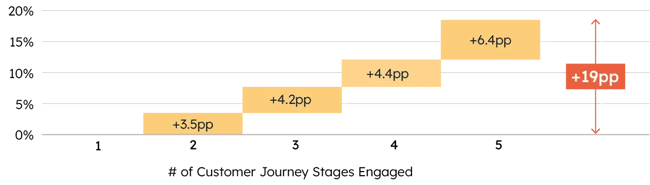
This finding highlights the need for a holistic approach. Customer connection is not just a marketing or sales responsibility. It is an effort that must be carried out throughout the entire company. Every touchpoint, from initial discovery to post-purchase support, is an opportunity to strengthen the relationship.
Companies that connect with customers at every opportunity are winning. They build trust and loyalty that translates into repeat business and referrals. This end-to-end strategy ensures that no part of the customer journey is neglected.
The Five Stages of Engagement
- Aware: Customers become aware of your brand through content, ads, or social media.
- Prospect: Potential customers show interest and provide contact information.
- Lead: Qualified prospects are nurtured with personalized communication.
- Deal: Sales teams engage directly to close the sale.
- Customer: Post-purchase support and engagement turn customers into advocates.
Engaging at each stage requires a coordinated effort. Marketing, sales, and service teams must work together to ensure a seamless experience. This alignment is critical for maximizing growth.
Multi-Channel Engagement Strategies
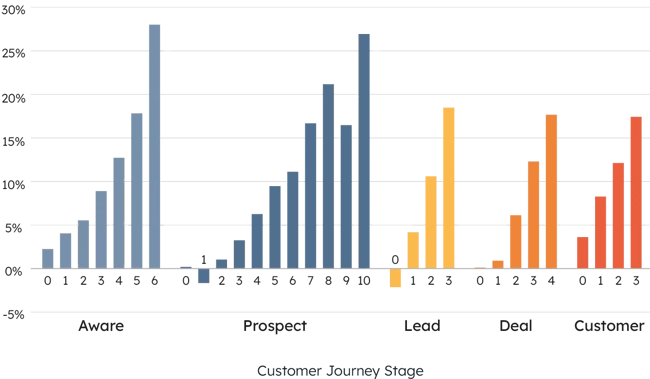
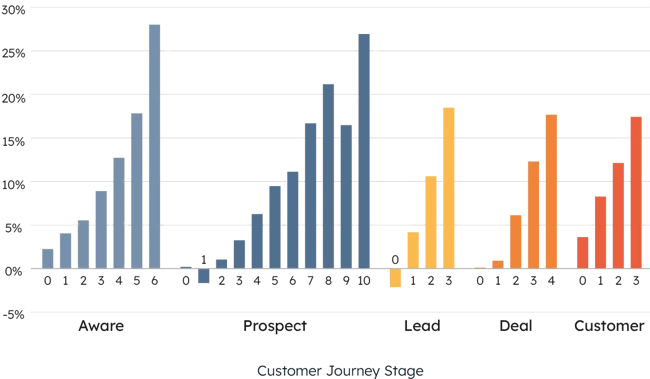
Using multiple channels within each journey stage leads to better connection and growth. Companies in the top 20% of connections are committed to meeting their customers where they are. They use a variety of features to engage with customers at each lifecycle stage.
The effectiveness of different features varies by industry. For manufacturing, outbound calling, tickets, and meeting links are top drivers of growth. In software or IT, sales email, ads, and meeting links are more significant. Professional services companies find that sales email, ads, and A/B testing are most effective.
This diversity in approach underscores the importance of customization. There is no one-size-fits-all solution. Businesses must identify the channels that resonate with their specific audience. This requires a deep understanding of customer preferences and behaviors.
By leveraging multiple channels, companies can create a richer, more engaging experience. This multi-channel approach ensures that customers receive consistent and relevant communication, regardless of how they interact with the brand.
Industry-Specific Channel Priorities
| Industry | Top Growth-Driving Features |
|---|---|
| Manufacturing | Outbound calling, tickets, meeting links |
| Software/IT | Sales email, ads, meeting links |
| Professional Services | Sales email, ads, A/B testing |
Understanding these nuances is essential for optimizing engagement. Managers should analyze their own data to determine which channels are most effective for their audience.
Balancing Human and Scaled Tactics
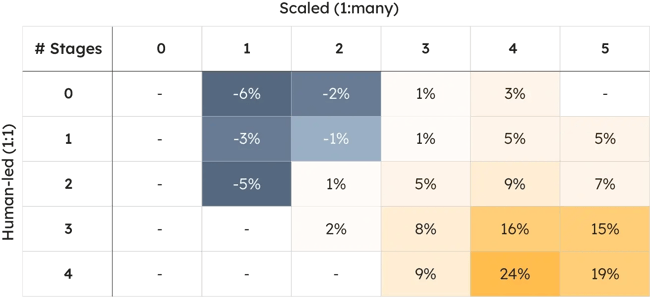
The combination of human-led and scaled (one-to-many) tactics is key to maximizing growth. When both tactics are used across the entire lifecycle, companies see a 19% growth boost. This balance is crucial because it leverages the efficiency of automation while maintaining the personal touch of human interaction.
Human-led connection is more prevalent and impactful later in the customer lifecycle. Customers who omit human connection in the deal and customer stages experience negative growth (-1%). This suggests that as relationships deepen, personal interaction becomes increasingly important.
AI tools can handle repetitive tasks and provide personalized content at scale. However, they cannot replace the empathy and nuance of human conversation. The most successful companies use AI to free up their teams for higher-value, human-centric interactions.
This hybrid approach allows businesses to scale their efforts without sacrificing quality. It ensures that every customer feels valued and understood, regardless of the size of the organization.
The Role of AI in Human Connection
AI can assist in:
- Personalizing email content at scale.
- Identifying high-value leads for human outreach.
- Providing real-time insights to support agents.
However, AI should not replace:
- Complex problem-solving.
- Empathetic listening.
- Strategic relationship building.
The goal is to enhance human connection, not replace it. By using AI wisely, companies can create more meaningful and impactful interactions.
Closing the Connection Gap
The theme is clear: the fastest-growing companies make customer connection a priority. They think holistically across the entire customer journey. They use multiple modalities to engage with customers through preferred channels. They rely on both scaled and human-led tactics in tandem.
It may seem daunting to implement such a comprehensive strategy. However, with a potential five times growth opportunity at stake, the most important thing is to get started. Small steps can lead to significant improvements over time.
HubSpot is committed to making this easy. They are investing in AI to level the playing field, so that even small teams can win on customer connection. This investment reflects a broader industry trend: technology is becoming more accessible, but the human element remains irreplaceable.
Businesses must rethink how they market, sell, and support their customers. Insights and strategies from HubSpot’s “Guide to Connection in the Age of AI” can help professional services, software, or manufacturing companies drive growth through building meaningful customer connections at scale.
For decision-makers in service industries and healthcare, this message is particularly relevant. These sectors rely heavily on trust and relationship-building. By prioritizing connection, they can differentiate themselves in a crowded market and build a loyal customer base.
Key Takeaways for Implementation
- Start Small: Identify one stage of the customer journey to focus on first.
- Analyze Data: Use analytics to understand which channels and tactics are most effective.
- Train Teams: Ensure that all team members understand the importance of connection.
- Leverage Technology: Use AI tools to automate repetitive tasks and free up time for human interaction.
By following these steps, companies can begin to close the connection gap and drive sustainable growth. The journey to becoming a top connector is ongoing, but the rewards are significant.
In the age of AI, the question is not whether to use technology, but how to use it to enhance human connection. The businesses that get this right will be the ones that thrive.





