When AI Recommends Your Competitors: Fixing Brand Visibility
You have likely experienced the sinking feeling of asking ChatGPT or Perplexity for a recommendation in your industry, only to watch it confidently suggest a competitor’s name while yours remains absent. It feels personal, but it is actually a fundamental shift in how the internet functions. We have spent decades mastering the art of chasing blue links, yet today, that traditional approach is hitting a wall. The reality is that search has moved beyond simple keyword matching and is now driven by complex reasoning and semantic authority.
If you are still pinning your growth strategy entirely on standard SEO metrics, you are playing a game that is rapidly losing its relevance. When a user asks an AI to solve a problem, the model is not browsing a list of links; it is synthesizing knowledge from its training data and real-time web access to provide a single, authoritative answer. If your brand is not embedded within that knowledge graph as a trusted entity, you simply do not exist in the conversation.
Learning how to optimize for AI search engines is the new baseline for business survival. To remain visible, you must pivot away from merely pleasing algorithms and start proving your value as a reliable, expert source of information. By aligning your digital footprint with the way large language models process trust and relevance, you can transition from an invisible player to a top-of-mind authority.
Understanding AI Ranking Signals: Beyond the Blue Links
When you ask an AI model a question, it is not scanning a list of blue links to find the page with the highest keyword density. Instead, it is performing a complex retrieval process based on its training data and real-time knowledge graphs. To succeed in this landscape, you must understand that AI models prioritize truth, accuracy, and perceived authority.
| Signal Type | Traditional Search (SEO) | AI Search (GEO) |
|---|---|---|
| Primary Metric | Backlink quantity | Citation frequency & sentiment |
| Content Focus | Keyword density | Semantic depth & accuracy |
| Link Value | Direct traffic | Entity association |
| Data Format | Unstructured HTML | Structured data & knowledge graphs |
The Shift from Keywords to Entities
Modern search engines have moved toward entity-based indexing. An entity is a person, place, organization, or concept that the AI recognizes as distinct. Your goal is to ensure your brand is consistently linked to the specific entities in your industry that the AI already trusts.
This concept is known as entity co-occurrence. You do not always need a direct hyperlink to benefit; simply being cited or mentioned in high-quality, authoritative contexts helps the AI map your relevance. Think of it as digital social proof: if the AI sees your brand regularly appearing alongside the experts it already respects, it begins to treat your brand as an expert entity itself.
Strategic Association: Building Authority Through Partner Adjacency
In the world of AI search, your brand is defined by the company you keep. By focusing on entity co-occurrence, you can signal to AI engines that your brand is a trusted participant in your industry’s ecosystem. This means moving beyond solo SEO efforts and strategically aligning yourself with non-competing partners, verified technologies, and established industry bodies.
Mapping Your Adjacent Entities
To improve your AI search visibility, you must identify the digital neighbors that hold significant weight in your niche. If your brand is missing from these conversations, you become invisible to the machine’s knowledge graph.
- Audit Competitor Citations: Use tools to see where your top competitors are mentioned. These are the hubs where AI gathers its facts.
- Identify Trusted Platforms: Look for industry forums or specialized publications that consistently rank in AI-generated summaries.
- Map Technology Partners: Ensure your brand is explicitly listed in partner directories or documentation of household-name software.
- Target Professional Associations: Membership in industry bodies is a strong signal of legitimacy.
The Role of Digital PR in Feeding AI Models
Digital PR is now about building a web of trust that feeds directly into LLM training sets. When you secure a mention in a high-authority publication alongside established industry leaders, you create a semantic bridge. This form of AI citation is powerful because it validates your expertise within the context of the wider market.
Structuring Your Content for AI Extraction
To master how to optimize for AI search engines, you must stop writing for human scanners and start writing for machine parsers. When your content is poorly structured, models may bypass your site in favor of competitors who offer cleaner, more accessible data.
Prioritizing Answer Engine Optimization
At the core of modern visibility is AEO (Answer Engine Optimization). Unlike traditional SEO, AEO aims to provide a concise, direct answer that an AI can extract as a snippet. Every primary page on your site should contain a 40-80 word summary block located near the top of the content. By placing this summary in plain, factual language, you make it effortless for an LLM to identify your content as a primary source of truth.
Using Technical Signposts for AI Crawlers
Beyond human-readable text, you must provide explicit technical instructions for crawlers. Schema Markup serves as the map of your content. Implementing specific types like FAQPage, How-To, and Organization schema helps search engines understand the relationship between your entities and the concepts you discuss.
| Characteristic | Why It Matters to AI |
|---|---|
| Evidence-based | AI favors factual claims that can be cross-referenced. |
| Concise structure | Short paragraphs prevent model confusion. |
| Logical H-tags | Clearly defines the topical focus. |
| Entity-rich | Mentions key industry terms to establish authority. |
Measuring What Matters: From Traffic to Share of Voice
When you learn how to optimize for AI search engines, traditional metrics like traffic volume become vanity. If your brand appears in the top three organic results but is ignored by an LLM summary, you are invisible to the modern user.
Defining AI Share of Voice (ASOV)
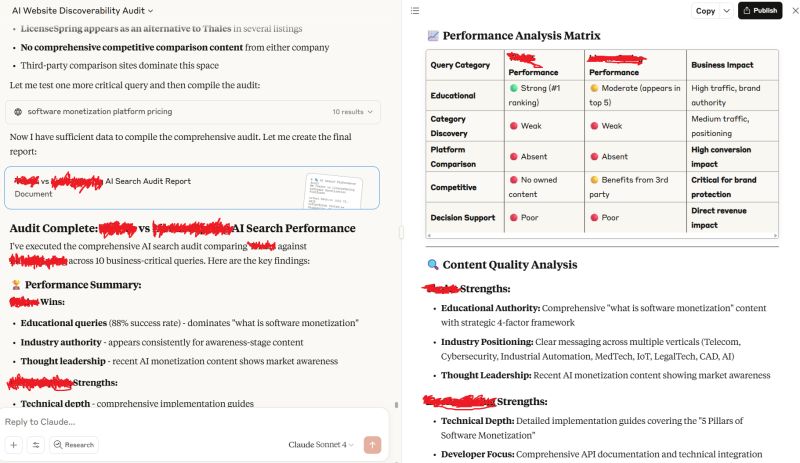
The new gold standard is AI Share of Voice (ASOV). ASOV measures how frequently and favorably your brand is cited as a trusted answer by AI models. To calculate your ASOV, you must audit the output generated by LLMs in response to your core industry questions. Track whether your brand appears as a primary entity or a secondary reference.
Monitoring Brand Sentiment
Beyond simple presence, you must ensure your brand is being labeled accurately. AI models categorize businesses based on thousands of data points. If your brand is an enterprise solution but is framed by AI as a budget option, your messaging is failing. Proactively auditing that narrative is how you maintain control over your digital reputation in the age of generative search.
According to AEO/GEO, achieving prominence in the era of AI is a long-term game that rewards clarity, accuracy, and depth. By anchoring your strategy in transparency and genuine expertise, you transform your brand into an indispensable resource that AI models can confidently feature in their responses.
AEO/GEO
Want to learn more?
Contact us for direct consultation and support.