How we Build with AI: A Practical Business Guide
It’s easy to feel like you’ve missed the starting gun. Every day, another headline promises that AI will flip a switch and turn your business into a high-octane machine. When you’re buried under the hype, it feels less like a transformation and more like a never-ending game of tech catch-up.
But the secret most headlines leave out is that successful How we Build with AI initiatives rarely happen overnight. They aren’t the result of a single, massive system migration. Instead, they are built through quiet, deliberate, and measurable steps. Think of it like adding a new, highly skilled employee to your team every quarter—someone who gets faster and more capable the longer they work with you.
When you shift your mindset from chasing trends to building a sustainable, AI-driven engine for growth, you stop worrying about the noise and start focusing on the output. You can stop experimenting and start engineering real, compounding value in your business—one practical, high-impact step at a time.
Step 1: Start with What Works (The Co-pilot Era)
The most effective AI adoption strategy for business begins not with grand overhauls, but with low-risk, high-reward entry points. Think of this as the “co-pilot era,” where you introduce intelligence to existing workflows rather than replacing them entirely. By focusing on AI-assisted writing or coding co-pilots, you allow your staff to get comfortable with technology in a supportive, controlled environment.
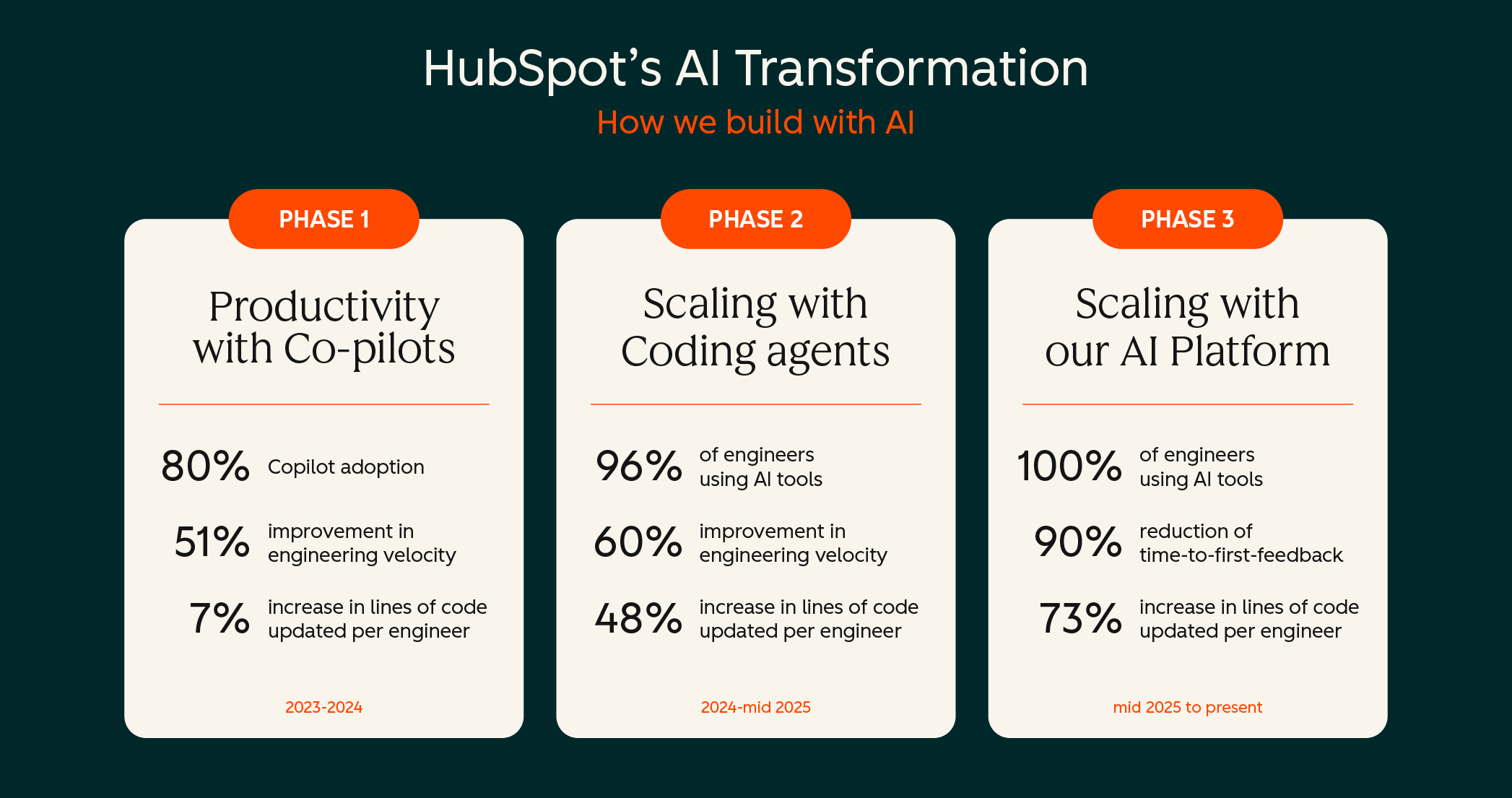
Before mandating new software, establish a baseline for your team’s current output. Without knowing how long a task takes or what the quality bar looks like, it’s impossible to measure the success of an AI implementation. Start by tracking metrics like “time to first draft” or “number of bugs fixed per sprint” manually for two weeks. This data provides the objective proof needed to justify your practical AI implementation for small business efforts later.
Reframing the Psychological Barrier
A major hurdle in early adoption is the fear that AI will replace employees. You must reframe this conversation immediately. Instead of framing these tools as replacements, position them as a productivity multiplier. When you show a writer how a co-pilot can handle repetitive research or a developer how an assistant can suggest boilerplate code, the focus shifts from displacement to empowerment.
You aren’t removing the human; you are removing the friction that prevents your team from doing their best work. When team members see their output increase without a corresponding increase in exhaustion, the fear of replacement turns into a desire to master the new tool.
Comparison: Traditional vs. AI-Assisted Workflow
To help your team understand the shift, contrast the old way of working with the new reality. This comparison clarifies why AI engineering productivity matters in day-to-day operations.
| Task | Manual Workflow | AI-Assisted Workflow |
|---|---|---|
| Drafting/Coding | Start from scratch | Generate base; iterate |
| Review | Peer review only | AI logic check + peer review |
| Iteration | Slow manual revisions | Instant suggestions |
By starting with small, measurable wins, you prove the value of AI through results rather than theory. This builds a culture of confidence that sustains your business through more complex phases of digital transformation.
Step 2: Moving from Tools to Autonomous Agents
The transition from using simple AI chat assistants to deploying autonomous agents represents a fundamental shift in your AI adoption strategy for business. While a co-pilot helps you draft an email or debug code, an agent moves beyond answering questions to actually executing multi-step workflows. Think of an agent as a digital employee that can interact with software, retrieve information, and finish tasks without constant hand-holding. This capability is essential for scaling with AI agents effectively, moving you from manual prompting to automated output.
The Power of Contextual Awareness
For an agent to be useful, it requires “context”—direct access to your internal data, documentation, and specific business systems. Without this, an agent is just a generic model operating in a vacuum. By granting agents permissions to reach into your CRM, project management tools, or knowledge bases, you allow them to perform actions specific to your business requirements.
Testing Agents in the Real World
Transitioning to autonomous systems requires a disciplined approach. You aren’t trying to remove human oversight; you are elevating human judgment. By letting AI handle repetitive, rules-based tasks, your team gains the bandwidth to focus on high-level decision-making.
When you are ready to pilot an agent, follow this three-step checklist:
- Set Parameters: Define narrow, measurable boundaries for the agent. For example, instead of “manage sales,” have it “draft responses to support tickets using our internal FAQ documentation.”
- Supervise Output: During the initial phase, require a “human-in-the-loop” approval step for every action the agent takes. Review the work for accuracy, tone, and compliance.
- Iterate: Use the feedback from your supervision to refine the agent’s instructions or the data it accesses. If the agent makes a mistake, treat it as a data problem—adjust the system prompt or the knowledge source rather than blaming the technology.
Step 3: Building a Foundation That Compounds Value
When you start experimenting with AI, it’s easy to fall into the trap of “tool sprawl.” This happens when you adopt a standalone AI writing app, then a coding assistant, and perhaps a third tool for summarizing meeting notes. Initially, these tools feel like quick wins. Over time, however, they become digital silos. Because these applications don’t talk to each other, your data remains fractured, and your team wastes time moving information between systems.
To move past this, adopt a platform-first approach. Instead of buying a tool for every isolated task, focus on building a cohesive ecosystem where your internal data acts as the common thread. When your AI systems share a common data foundation, each new feature or agent inherits the knowledge generated by the previous one. This creates a compounding effect, making future AI innovation exponentially faster and more reliable.
The Power of Connected Systems
When your AI agents have access to a centralized, clean, and secure data repository, they stop operating as isolated widgets and start functioning as an intelligent business engine. This is critical for scaling with AI agents effectively. A unified foundation ensures that:
- Consistent Brand Voice: Every piece of content or customer response generated by your AI aligns with your established tone and guidelines.
- Unified Customer Experience: An agent in customer support can see the same context as an agent in sales, preventing disjointed interactions.
- Measurable Productivity: You can clearly track performance metrics because all AI activities flow through a central hub.
Avoiding the Fragmented Trap
Many organizations struggle because they treat AI as a plug-and-play addition rather than a structural change. When you prioritize connectivity, you reduce the friction of future adoption. If a tool cannot integrate with your primary data pipeline, it should be treated with extreme caution. This connect-first mindset is the secret to a sustainable AI adoption strategy for business.
Cultivating an AI-First Culture (Without the Overwhelm)
Building an AI-first culture is less about technical brilliance and more about psychological safety. When teams feel the pressure to adopt every new tool instantly, they don’t innovate; they freeze. To truly master How we Build with AI, you must transform the workplace into a sandbox where experimentation is encouraged. Creating a safe space means acknowledging that some experiments will fail, and that is a necessary cost of learning.
The Power of Transparency and Purpose
Transparency is your most effective tool for gaining team buy-in. When introducing new AI software, avoid the trap of productivity for productivity’s sake. Instead, clearly articulate the why. By framing AI as a productivity multiplier rather than a replacement, you turn fear into enthusiasm.
Explain that these tools handle the heavy lifting—the repetitive, draining tasks that sap energy and focus. When you offload the drudgery to AI, your team gains back the mental bandwidth needed for high-level strategy, creative problem-solving, and building genuine human connections with customers.
The 4-Question Adoption Audit
Before rushing into any new subscription, evaluate its fit. Rushing into tool adoption often leads to fragmented workflows and wasted budget. Use this checklist to determine if a new AI tool is worth your team’s time:
| Evaluation Question | Why It Matters |
|---|---|
| Integrates with workflow? | Prevents tool sprawl. |
| Data security verified? | Protects your intellectual property. |
| Success metrics clear? | Allows you to measure actual ROI. |
| Internal champion identified? | Ensures someone is accountable. |
Building an AI-first culture means treating technology as a teammate, not an overlord. By providing the resources and freedom for your staff to learn by doing, you foster a sense of ownership. Encourage your team to start small—perhaps by using an AI agent to summarize meeting transcripts or to draft project documentation. As they see the tangible benefits of saving hours of work, their confidence will naturally increase.
Mastering How we Build with AI is not about chasing the latest tool. It is a game of strategy, where your ability to integrate technology intentionally determines your long-term success. By starting small with targeted applications and focusing on iterative improvements, you build a sustainable strategy that matures alongside your team. True progress comes from connecting your data and workflows, creating a foundation that compounds value over time. Each small experiment acts as a building block for scaling with AI agents and building an AI-first culture that remains adaptable to future shifts.
The goal remains consistent: let AI handle the heavy lifting of repetitive tasks so your team can focus on high-level creativity and strategic decision-making. Treat your technology stack like a living project, keep your implementation practical, and watch as these small, deliberate steps transform your operational efficiency into a genuine competitive advantage. Your journey to becoming an AI-driven organization starts with the next decision you make.
AEO/GEO
Want to learn more?
Contact us for direct consultation and support.